19
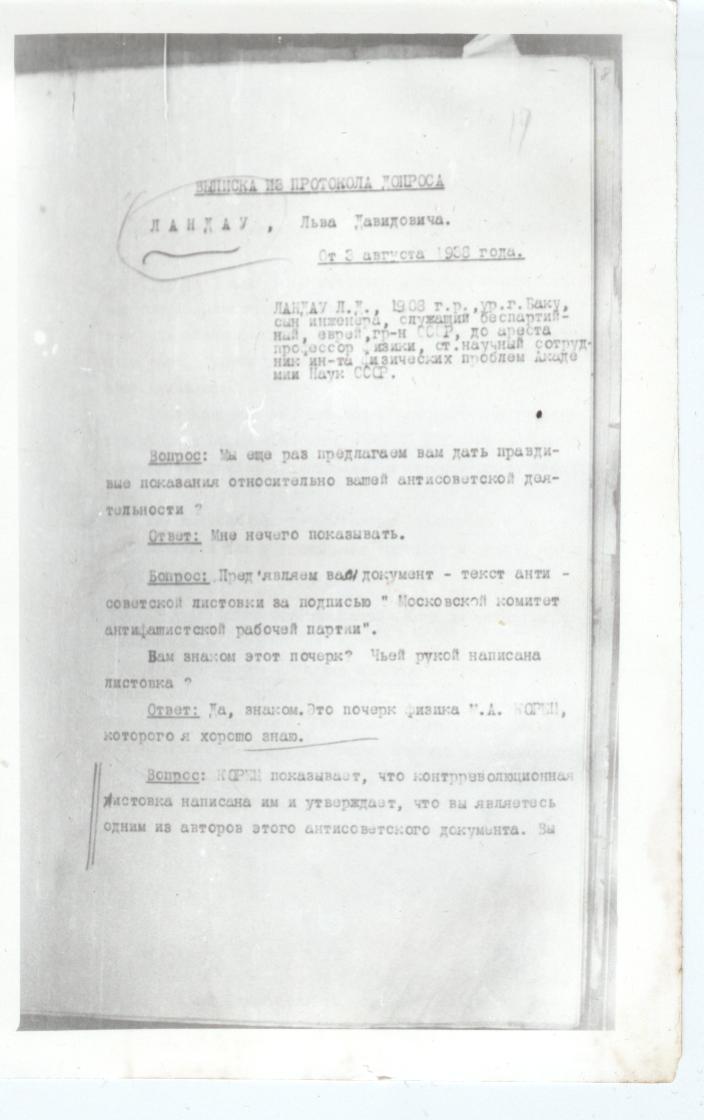
EXTRACT FROM THE INTERROGATION RECORD
OF LANDAU, Lev Davidovich.
Of 3 August 1938.
LANDAU L.D., b. 1908, native of the city of Baku,
son of an engineer, a non-party employ-
ee, a Jew, a citizen of the USSR, before his arrest
a professor of physics, a senior scientific work-
er at the Institute of Physical Problems of the Acade-
my of Sciences of the USSR.
Question: Once again we propose that you give truth-
ful testimony concerning your anti-Soviet activ-
ity?
Answer: I have nothing to testify.
Question: We present to you a document - the text of an anti-
Soviet leaflet signed "Moscow Committee
of the Anti-Fascist Workers' Party".
Is this handwriting familiar to you? By whose hand was
the leaflet written?
Answer: Yes, it is familiar. It is the hand of the physicist M.A. KORETS,
whom I know well.
Question: KORETS testifies that the counterrevolutionary
leaflet was written by him and asserts that you are
one of the authors of this anti-Soviet document. You
P. 20
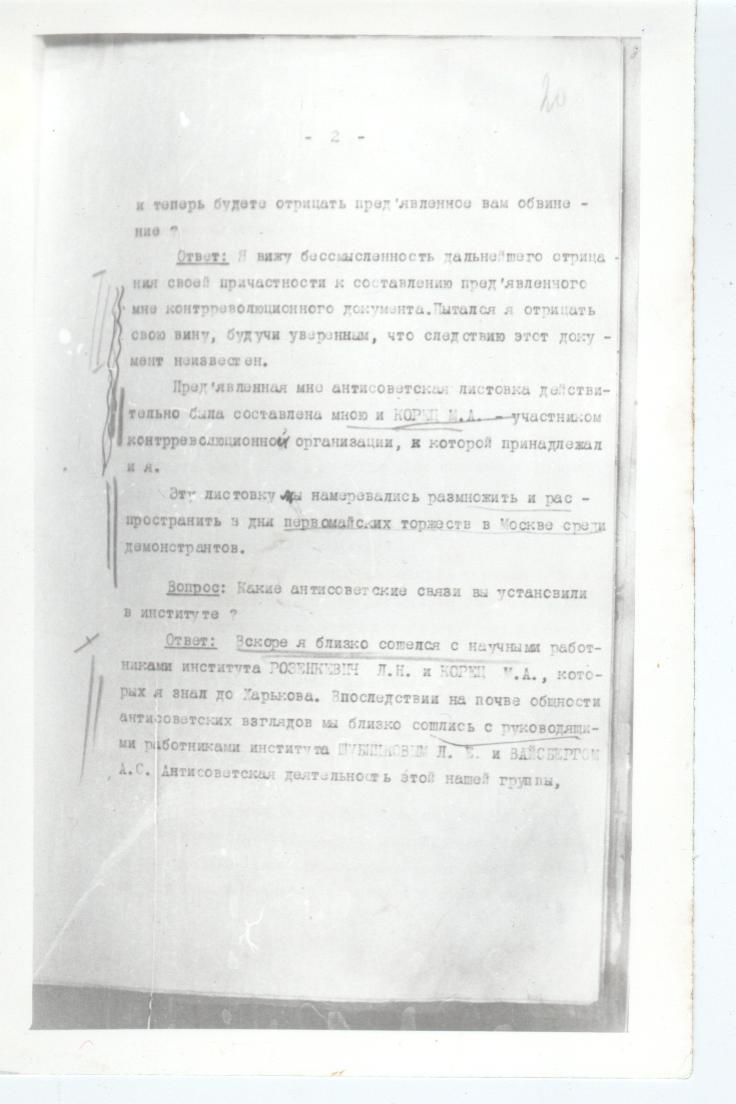
- 2 -
20
and will you even now deny the charge brought
against you?
Answer: I see the pointlessness of any further deni-
al of my part in composing the document presented
to me, a counterrevolutionary one. I tried to deny
my guilt, confident that this docu-
ment was unknown to the investigation.
The anti-Soviet leaflet presented to me was in-
deed composed by me and by KORETS M.A., a member
of the counterrevolutionary organization to which
I too belonged.
This leaflet we intended to duplicate and to dis-
tribute in the days of the May Day celebrations in Moscow among
the demonstrators.
Question: What anti-Soviet ties did you establish
at the institute?
Answer: I soon became close to the scientific work-
ers of the institute, ROZENKEVICH L.V. and KORETS M.A., whom
I had known before Kharkov. Later, on the ground of shared
anti-Soviet views, we became close to the lead-
ing workers of the institute, SHUBNIKOV L.V. and VAISBERG
A.S. The anti-Soviet activity of this group of ours,
P. 21
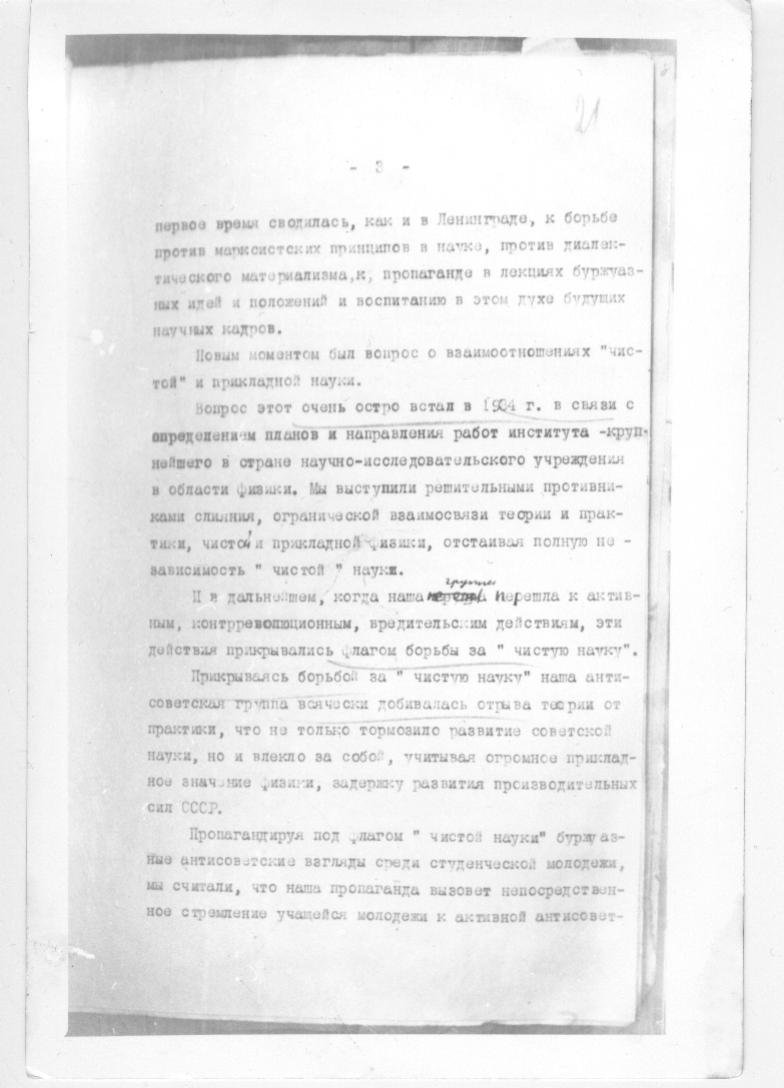
- 3 -
21
at first came down, as in Leningrad too, to a struggle
against Marxist principles in science, against dialec-
tical materialism, to preaching in lectures bourge-
ois ideas and propositions, and to training in that spirit future
scientific cadres.
A new point was the question of the relation between "pu-
re" and applied science.
This question arose very sharply in 1934, in connection with
defining the plans and the direction of the institute's work - the lar-
gest research institution in the country
in the field of physics. We came forward as determined oppon-
ents of a merger, of an organic link between theory and prac-
tice, between pure and applied physics, upholding the complete in-
dependence of "pure" science.
And later, when our [illegible] of the group passed over to act-
ive, counterrevolutionary, wrecking actions, these
actions were covered by the flag of the struggle for "pure science".
Covering itself with the struggle for "pure science", our anti-
Soviet group sought in every way to tear theory away from
practice, which not only held back the development of Soviet
science but also entailed, given the enormous applied
importance of physics, a delay in the development of the productive
forces of the USSR.
Preaching under the flag of "pure science" bourge-
ois anti-Soviet views among the student youth,
we reckoned that our propaganda would call forth an immediate
striving of the student youth toward active anti-Sovi-
P. 22
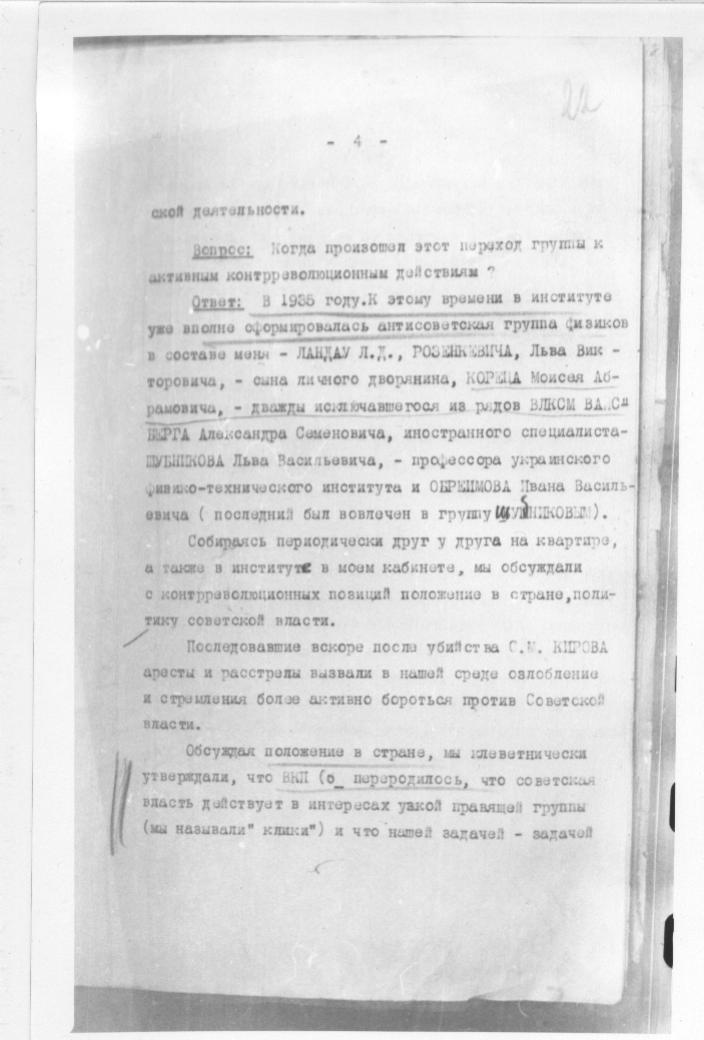
- 4 -
22
et activity.
Question: When did this transition of the group to
active counterrevolutionary actions take place?
Answer: In 1935. By that time there had fully
formed at the institute an anti-Soviet group of physicists,
consisting of me - LANDAU L.D., of ROZENKEVICH, Lev Vik-
torovich, - son of a personal nobleman, of KORETS Moisey Ab-
ramovich, - twice expelled from the ranks of the VLKSM, of VAIS-
BERG Alexander Semyonovich, a foreign specialist,
of SHUBNIKOV Lev Vasilyevich, - professor of the Ukrainian
Physico-Technical Institute, and of OBREIMOV Ivan Vasil-
yevich (the last was drawn into the group by SHUBNIKOV).
Meeting from time to time at one another's apartments,
and also at the institute, in my office, we discussed,
from counterrevolutionary positions, the situation in the country, the pol-
icy of the Soviet power.
The arrests and shootings that followed soon after the murder of S.M. KIROV
aroused bitterness in our midst
and an urge to fight more actively against the Soviet
power.
Discussing the situation in the country, we slanderously
asserted that the VKP(b) had degenerated, that the Soviet
power acts in the interests of a narrow ruling group
(we called it a "clique") and that our task - the task
P. 23
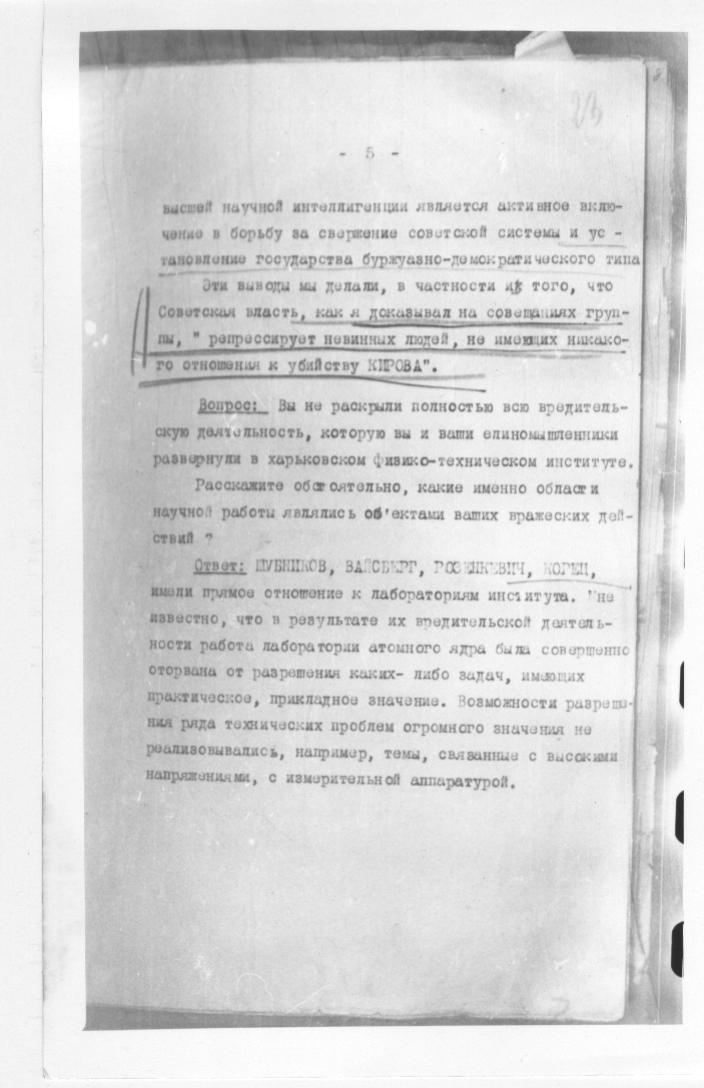
- 5 -
23
of the higher scientific intelligentsia is an active join-
ing in the struggle to overthrow the Soviet system and to es-
tablish a state of the bourgeois-democratic type
These conclusions we drew, in particular, from the fact that
the Soviet power, as I argued at the meetings of the gro-
up, "represses innocent people who have no
connection with the murder of KIROV".
Question: You have not fully disclosed all the wreck-
ing activity which you and your like-minded fellows
unfolded at the Kharkov Physico-Technical Institute.
Tell us in detail precisely which fields
of scientific work were the objects of your hostile act-
ions?
Answer: SHUBNIKOV, VAISBERG, ROZENKEVICH, KORETS
had a direct relation to the laboratories of the institute. I
know that, as a result of their wrecking activ-
ity, the work of the atomic-nucleus laboratory was entirely
cut off from solving any problems that had
a practical, applied importance. The possibilities of solv-
ing a number of technical problems of enormous importance were not
realized, for example the subjects connected with high
voltages and with measuring apparatus.
P. 24
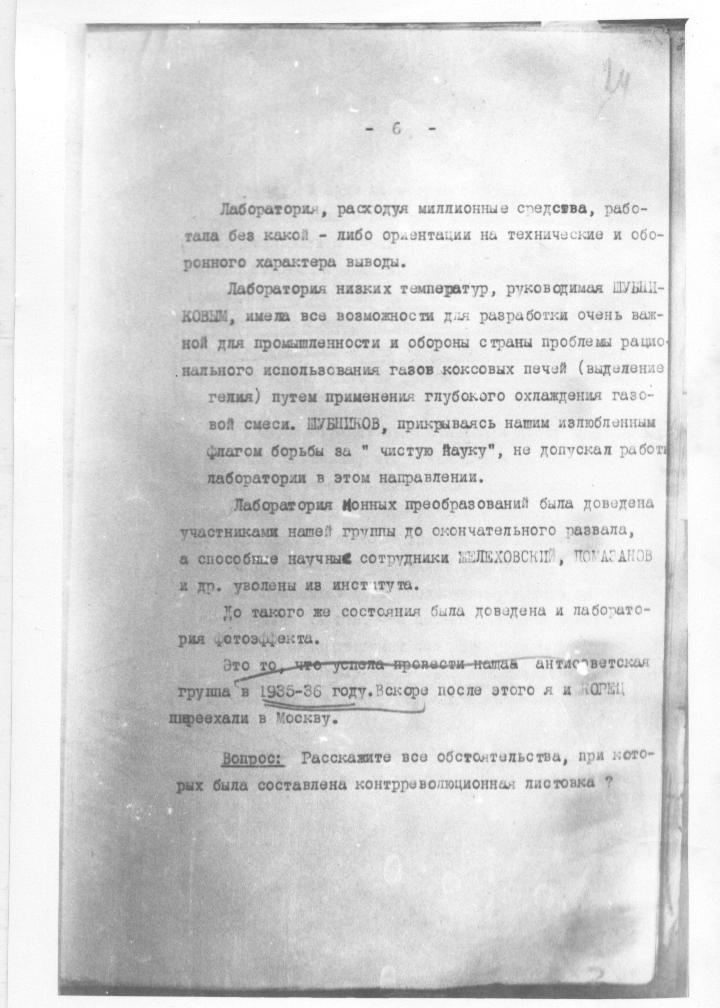
- 6 -
24
The laboratories, while spending millions, work-
ed without any orientation toward conclusions of a technical and de-
fense character.
The low-temperature laboratory, headed by SHUBNI-
KOV, had every possibility of working out a very import-
ant problem for the country's industry and defense: the ratio-
nal use of the gases of coke ovens (the separation
of helium) by applying deep cooling to the gas
mixture. SHUBNIKOV, covering himself with our favorite
flag of the struggle for "pure Science", did not allow the work
of the laboratory in that direction.
The laboratory of ionic transformations was brought
by the members of our group to a final collapse,
and capable scientific workers, ZHELEKHOVSKY, POGASANOV,
and others, were dismissed from the institute.
The photoelectric laboratory was brought to the same
state.
This is what our anti-Soviet
group managed to carry out in 1935-36. Soon after that, KORETS and I
moved to Moscow.
Question: Tell us all the circumstances in which
the counterrevolutionary leaflet was composed?
P. 25
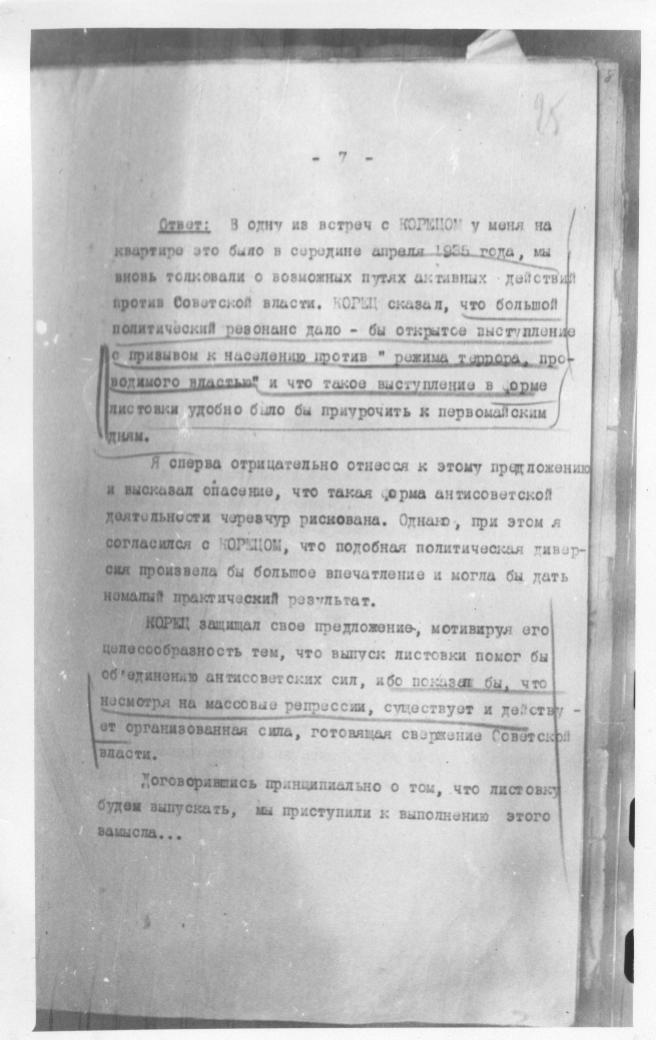
- 7 -
25
Answer: At one of my meetings with KORETS at my
apartment, this was in the middle of April 1935, we
again talked over possible ways of active action
against the Soviet power. KORETS said that a great
political resonance would be produced by an open appearance
with an appeal to the population against "the regime of terror car-
ried on by the authorities", and that such an appearance, in the form
of a leaflet, would conveniently be timed to the May Day
days.
At first I took a negative view of this proposal
and expressed the fear that such a form of anti-Soviet
activity was too risky. At the same time, however, I
agreed with KORETS that such a political diver-
sion would make a great impression and might yield
a considerable practical result.
KORETS defended his proposal, justifying its
expediency by the argument that issuing a leaflet would help
to unite the anti-Soviet forces, for it would show that,
despite the mass repressions, there exists and there act-
s an organized force preparing the overthrow of the Soviet
power.
Having agreed in principle that the leaflet
we would issue, we set about carrying out this
design...
P. 26
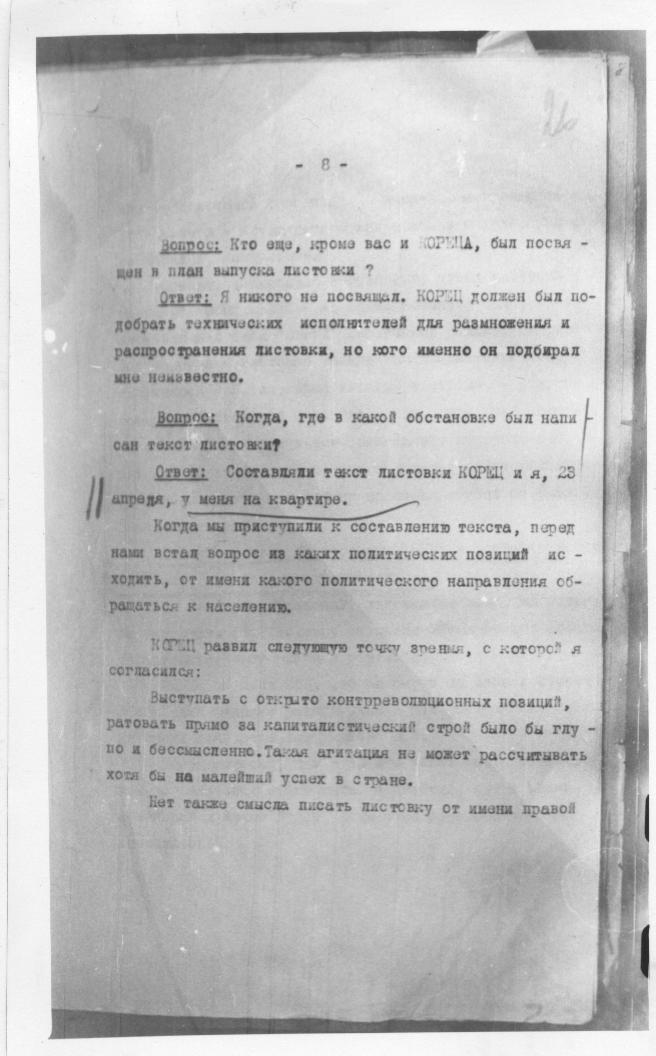
- 8 -
26
Question: Who else, besides you and KORETS, was let
in on the plan to issue the leaflet?
Answer: I let no one in on it. KORETS was to se-
lect technical people to duplicate and
distribute the leaflet, but whom exactly he chose
I do not know.
Question: When, where, and in what setting was writ-
ten the text of the leaflet?
Answer: The text of the leaflet was composed by KORETS and me, on 23
April, at my apartment.
When we set about composing the text, before
us arose the question from what political positions to pro-
ceed, in the name of what political tendency to ad-
dress the population.
KORETS developed the following point of view, with which I
agreed:
To come forward from openly counterrevolutionary positions,
to plead outright for the capitalist order, would be fool-
ish and senseless. Such agitation cannot count
on even the slightest success in the country.
Nor is there any point in writing a leaflet in the name of a right
P. 27
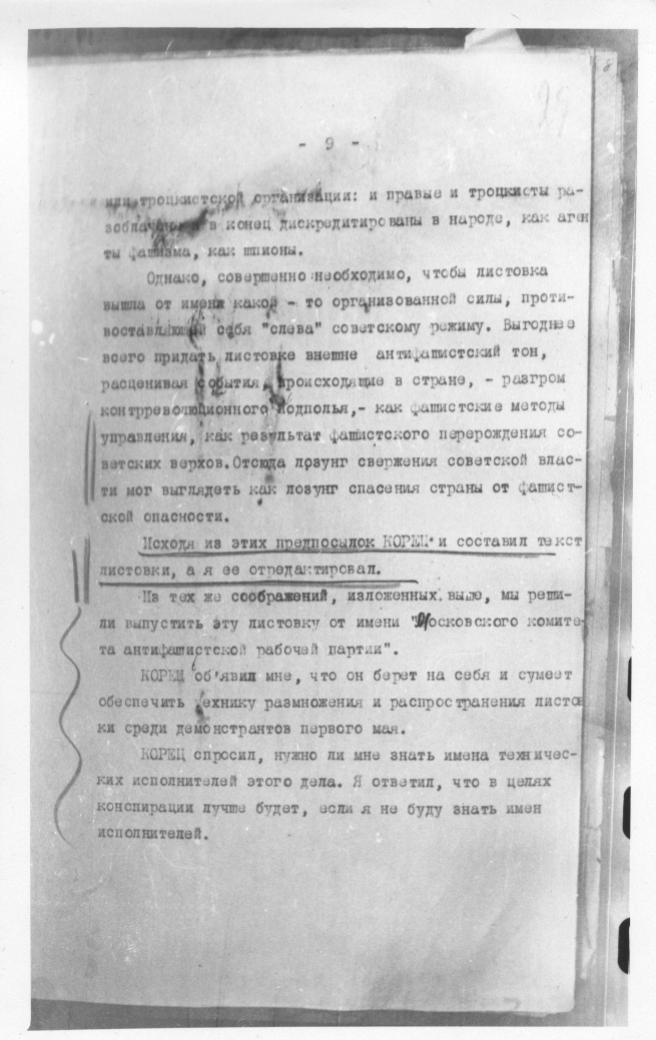
- 9 -
27
or a Trotskyist organization: both the Right and the Trotskyists have been
exposed [illegible] and utterly discredited among the people, as ag-
ents of fascism, as spies.
It is, however, quite necessary that the leaflet
come out in the name of some organized force, setting
itself "from the left" against the Soviet regime. It is most advantageous
of all to give the leaflet an outwardly anti-fascist tone,
treating the events taking place in the country - the crushing
of the counterrevolutionary underground - as fascist methods
of government, as the result of a fascist degeneration of the So-
viet summits. From this the slogan of overthrowing the Soviet pow-
er could look like a slogan of saving the country from the fascist
danger.
Proceeding from these premises, KORETS composed the text
of the leaflet, and I edited it.
On the same considerations, set out above, we decid-
ed to issue this leaflet in the name of the "Moscow Commit-
tee of the Anti-Fascist Workers' Party".
KORETS declared to me that he was taking it upon himself and would be able
to secure the technique of duplicating and distributing the leaf-
let among the demonstrators of the First of May.
KORETS asked whether I needed to know the names of the techni-
cal executors of this business. I replied that, for the sake
of conspiracy, it would be better if I did not know the names
of the executors.
P. 28
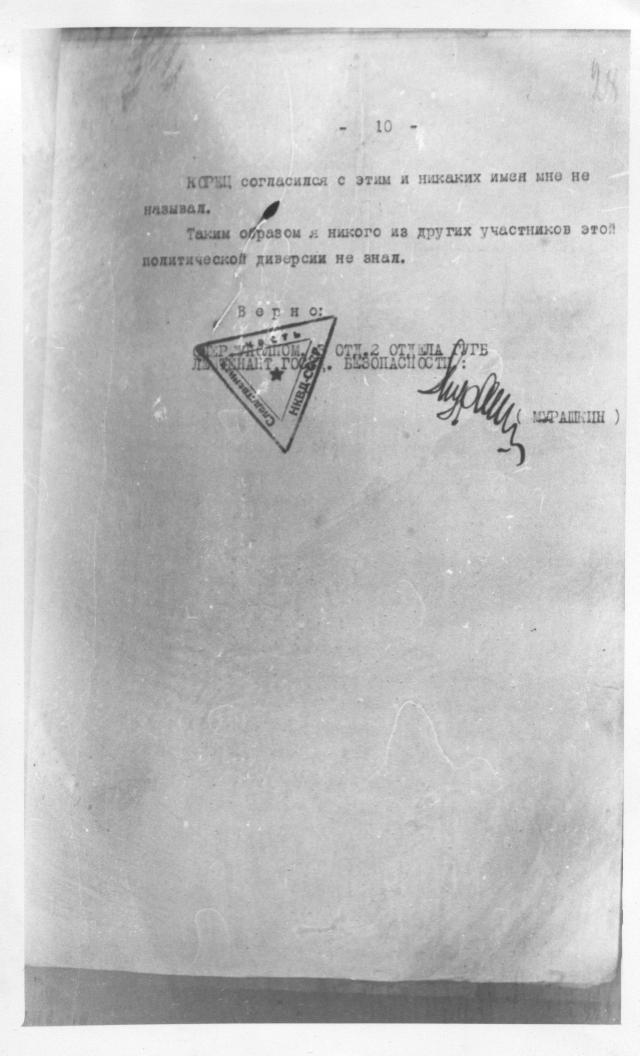
- 10 -
28
KORETS agreed to this and did not name
any names to me.
Thus I knew none of the other participants in this
political diversion.
Certified true:
OPERATIVE PLENIPOTENTIARY, 3RD SEC., 2ND DEPT. OF THE GUGB
LIEUTENANT OF STATE SECURITY:
[stamp]
[signature] (MURASHKIN)
The text is taken from photographs of the case file. Words that could not be made out are marked [illegible]. Where a page is too faint, only the photograph has been left.