A reading of the photograph, uncertain in places. Check it against the photograph.
29
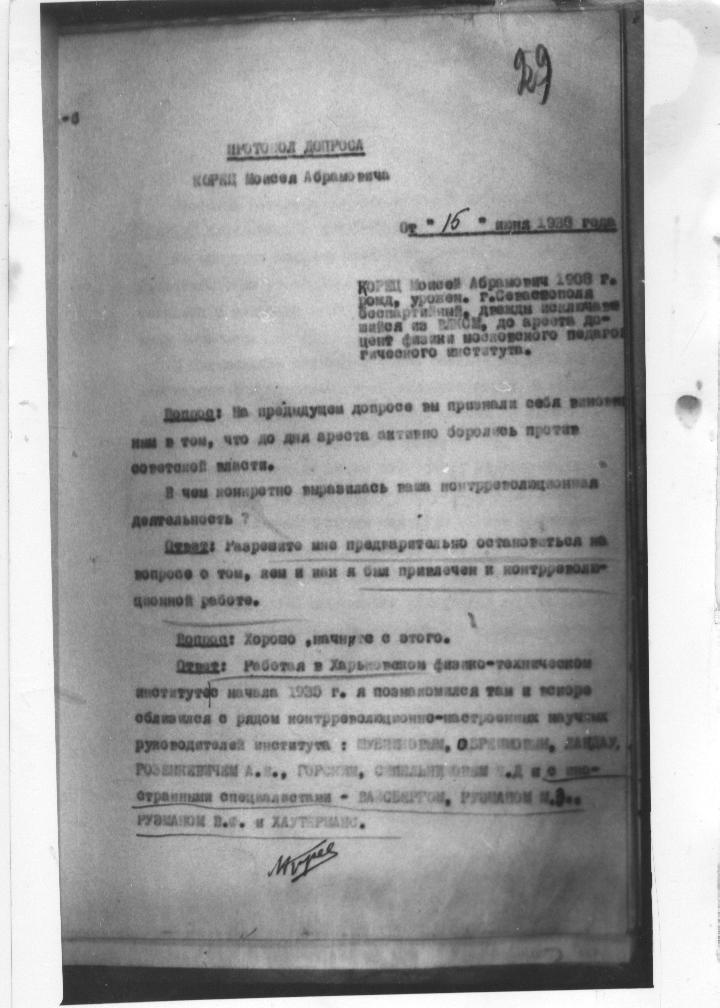
INTERROGATION RECORD
OF KORETS Moisey Abramovich
Of “16” July 1938.
KORETS Moisey Abramovich, 1908
born, native of the city of Sevastopol,
non-Party, twice expelled
[illegible] from the VLKSM, before the arrest a do-
cent of physics at the Moscow Pedagog-
ical Institute.
Question: At the previous interrogation you admitted yourself guil-
ty in that, until the day of the arrest, you actively fought against
Soviet power.
In what specifically was expressed your counterrevolutionary
activity?
Answer: Allow me first to dwell on
the question of by whom and how I was drawn into counterrevolu-
tionary work.
Question: Good, begin with that.
Answer: Working at the Kharkov Physico-Technical
Institute from the beginning of 1930 I became acquainted there and soon
grew close to a number of counterrevolutionarily minded scientific
leaders of the institute: LEIPUNSKY, OBREIMOV, LANDAU,
ROZENKEVICH L.V., GORSKY, [illegible] L.D. and with [illegible]
foreign specialists — WEISSBERG, RUZMAN M.Z.,
RUZMAN V.F. and HOUTERMANS.
[illegible]
P. 30
A reading of the photograph, uncertain in places. Check it against the photograph.
30
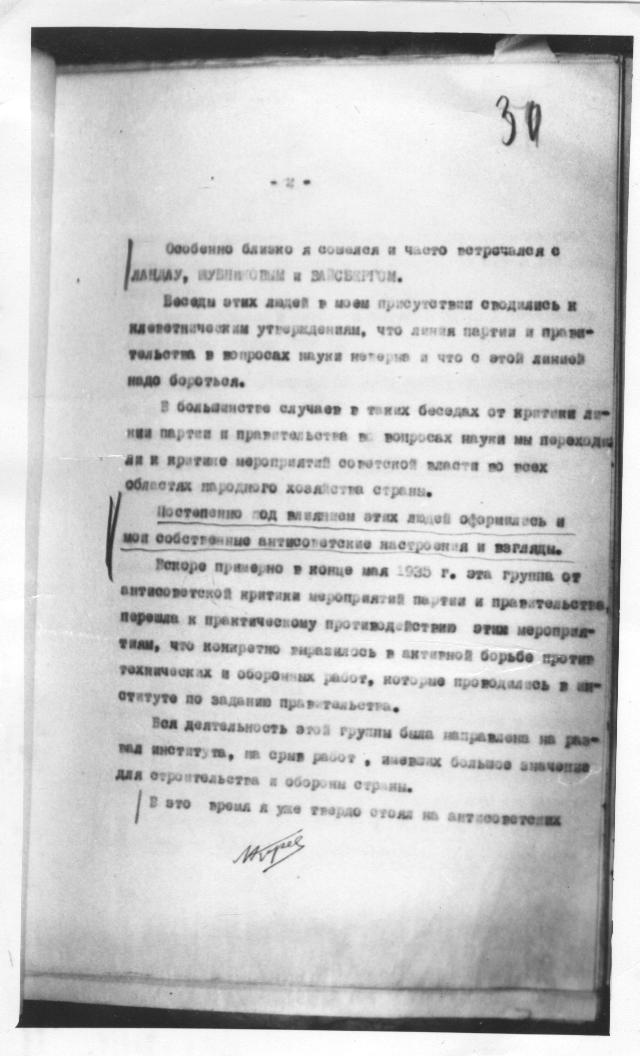
- 2 -
I grew especially close and often met with
LANDAU, SHUBNIKOV and WEISSBERG.
The conversations of these people in my presence came down to
slanderous assertions that the line of the Party and the govern-
ment in questions of science is wrong and that against this line
one must fight.
In most cases in such conversations from criticism of the li-
ne of the Party and the government in questions of science we pas-
sed to criticism of the measures of Soviet power in all
spheres of the national economy of the country.
Gradually under the influence of these people there took shape also
my own anti-Soviet moods and views.
Soon, approximately at the end of May 1935, this group from
anti-Soviet criticism of the measures of the Party and the government
passed to practical counteraction to these meas-
ures, which was specifically expressed in an active struggle against
the technical and defense works which were being carried out at the in-
stitute on the assignment of the government.
The whole activity of this group was directed at the break-
up of the institute, at the disruption of works that had great importance
for the construction and the defense of the country.
At that time I already stood firmly on anti-Soviet
[illegible]
P. 31
A reading of the photograph, uncertain in places. Check it against the photograph.
31
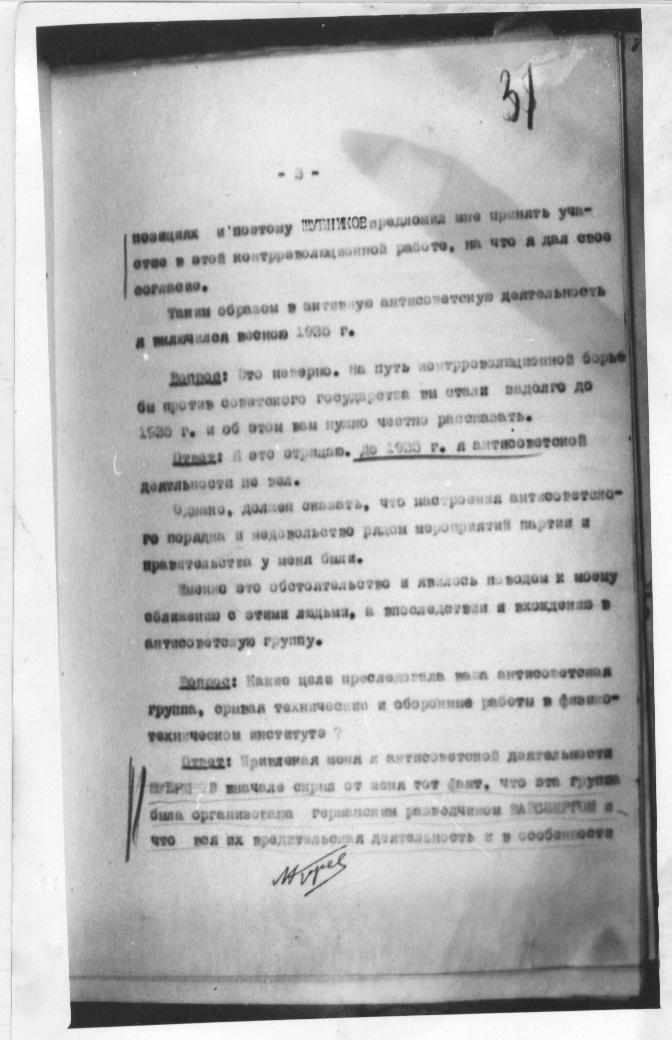
- 3 -
[illegible]positions and therefore LANDAU proposed that I take par-
ticipation in this counterrevolutionary work, to which I gave my
consent.
Thus into active anti-Soviet activity
I joined in the spring of 1936.
Question: That is untrue. Onto the path of counterrevolutionary strug-
gle against the Soviet state you stepped long before
1935, and about this you need to tell honestly.
Answer: I deny this. Before 1935 I conducted no anti-Soviet
activity.
However, I must say that moods of an anti-Soviet
order and dissatisfaction with a number of measures of the Party and
the government I did have.
It was precisely this circumstance that was the occasion for my
drawing close to these people, and subsequently also for entering
the anti-Soviet group.
Question: What aims did your anti-Soviet
group pursue, disrupting the technical and defense works at the Physico-
Technical Institute?
Answer: Drawing me into anti-Soviet activity,
LANDAU at first concealed from me the fact that this group
had been organized by the German intelligence agent WEISSBERG and
that the whole of their wrecking activity and especially
[illegible]
P. 32
A reading of the photograph, uncertain in places. Check it against the photograph.
32
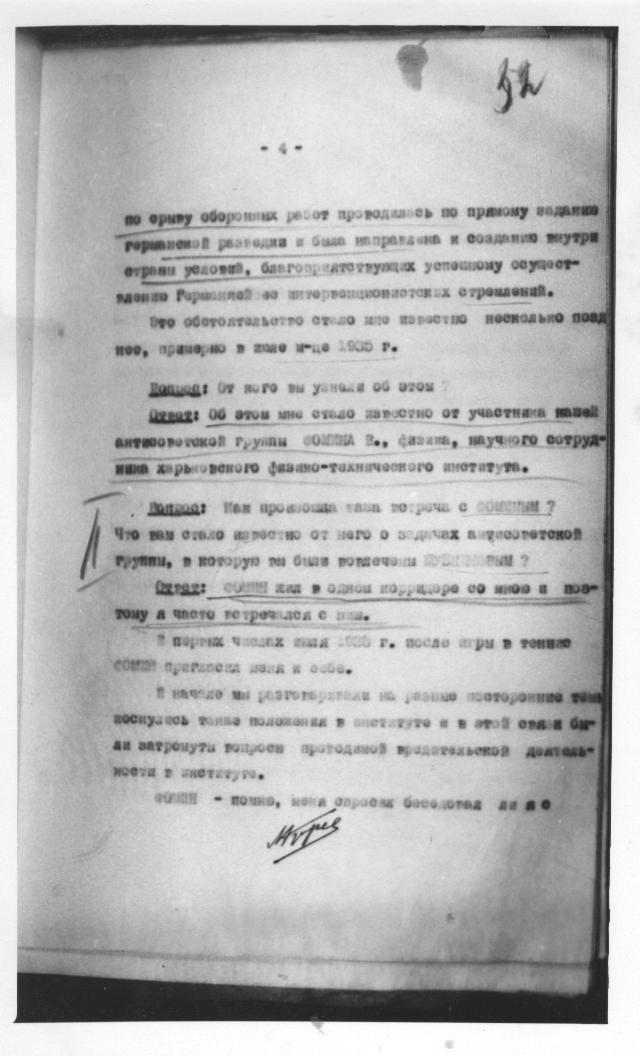
- 4 -
in the disruption of defense works was carried out on the direct assignment
of German intelligence and was directed at creating inside
the country conditions favorable to the successful realiza-
tion by Germany of its interventionist aspirations.
This circumstance became known to me somewhat lat-
er, approximately in the month of May 1935.
Question: From whom did you learn of this?
Answer: Of this I came to know from a participant of our
anti-Soviet group FOMIN V., a physicist, a scientific work-
er of the Kharkov Physico-Technical Institute.
Question: How did your meeting with FOMIN take place?
What became known to you from him about the tasks of the anti-Soviet
group into which you had been drawn [illegible]?
Answer: FOMIN lived in one corridor with me and there-
fore I often met with him.
In the first days of May 1935, after a game of tennis,
FOMIN invited me to his place.
At the beginning we talked on various extraneous subjects,
touched also the situation at the institute and in this connection there we-
re raised the questions of the wrecking activ-
ity being conducted at the institute.
FOMIN — I remember, asked me whether I had conversed with
[illegible]
P. 33
A reading of the photograph, uncertain in places. Check it against the photograph.
33
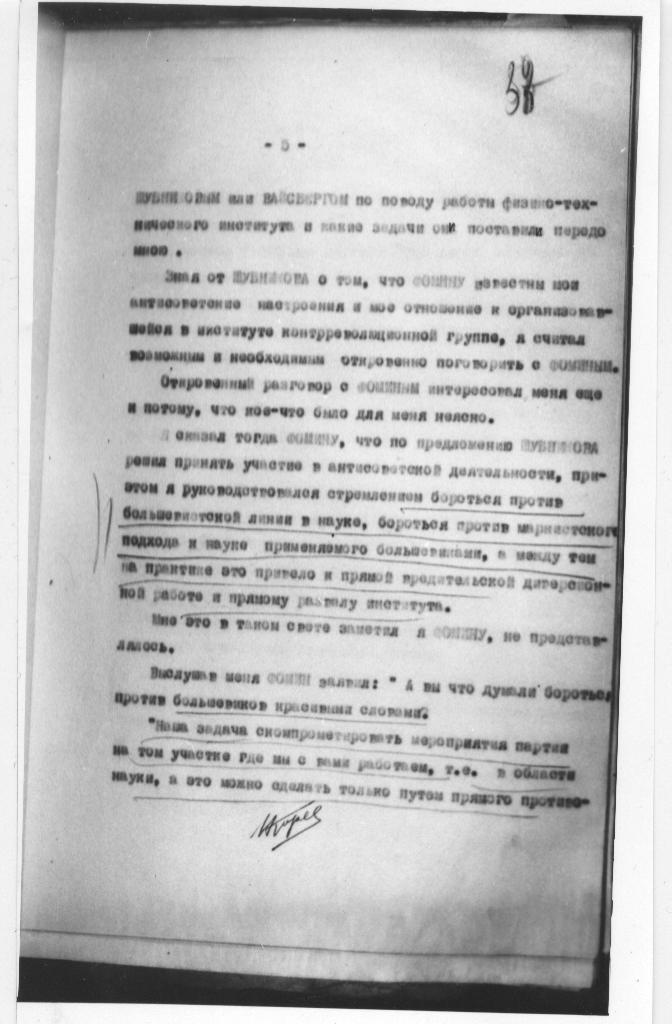
- 5 -
SHUBNIKOV or WEISSBERG concerning the work of the Physico-Tech-
nical Institute and what tasks they had set be-
fore me.
Knowing from SHUBNIKOV that to FOMIN were known my
anti-Soviet moods and my attitude to the organi-
zed at the institute counterrevolutionary group, I considered
it possible and necessary to speak frankly with FOMIN.
A frank conversation with FOMIN interested me also
for the reason that some things were unclear to me.
I said then to FOMIN that on the proposal of SHUBNIKOV
I had decided to take part in anti-Soviet activity; at
this I was guided by the striving to fight against
the Bolshevik line in science, to fight against the Marxist
approach to science applied by the Bolsheviks, and meanwhile
in practice this had led to outright wrecking diversion-
ary work and the outright breakup of the institute.
This in such a light, I remarked to FOMIN, did not pre-
sent itself to me.
Having heard me out FOMIN declared: "And what did you think, to fight
against the Bolsheviks with fine words?
Our task is to compromise the measures of the Party
on that sector where you and I work, that is, in the field
of science, and this can be done only by way of direct counter-
[illegible]
P. 34
A reading of the photograph, uncertain in places. Check it against the photograph.
34
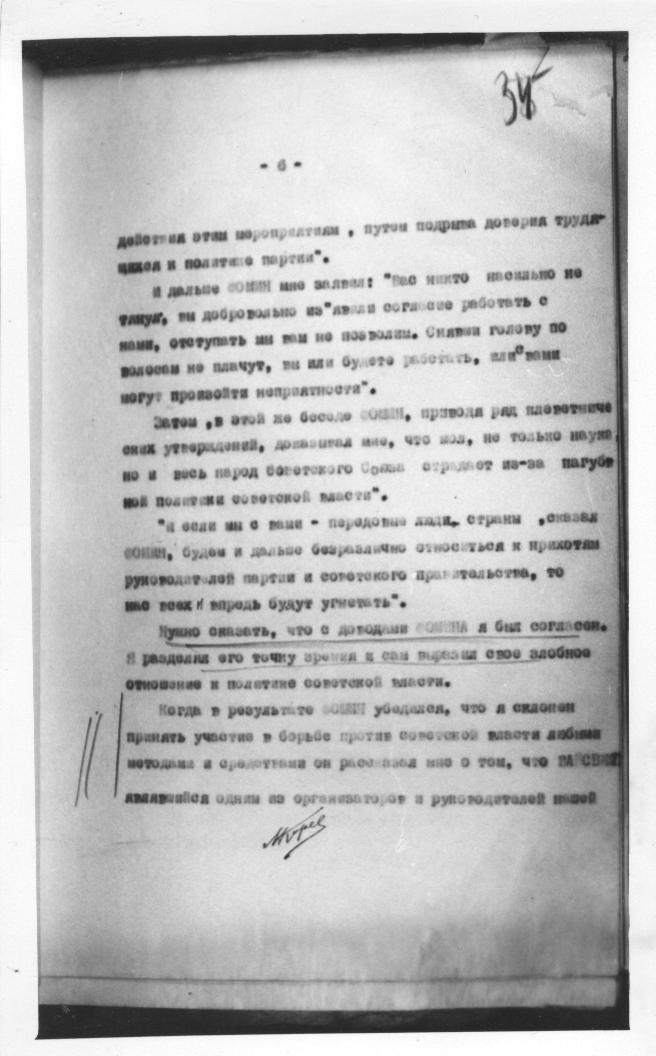
- 6 -
action to these measures, by way of undermining the trust of the work-
ing people in the policy of the Party".
And further FOMIN declared to me: "No one by force
is dragging you, you voluntarily expressed consent to work with
us, we will not allow you to retreat. Having taken off the head, over
the hair they do not weep, either you will work, or with you
unpleasant things may happen".
Then, in this same conversation, FOMIN, adducing a number of slander-
ous assertions, proved to me that, supposedly, not only science
but the whole people of the Soviet Union suffers because of [illegible]
policy of Soviet power".
"And if we with you — the advanced people of the country, — said
FOMIN, will go on relating indifferently to the whims
of the leaders of the Party and the Soviet government, then
all of us will go on being oppressed".
It must be said that with the arguments of FOMIN I was in agreement.
I shared his point of view and myself expressed my malicious
attitude to the policy of Soviet power.
When as a result FOMIN became convinced that I was inclined
to take part in the struggle against Soviet power by any
methods and means he told me that WEISSBERG,
who was one of the organizers and leaders of our
[illegible]
P. 35
A reading of the photograph, uncertain in places. Check it against the photograph.
35
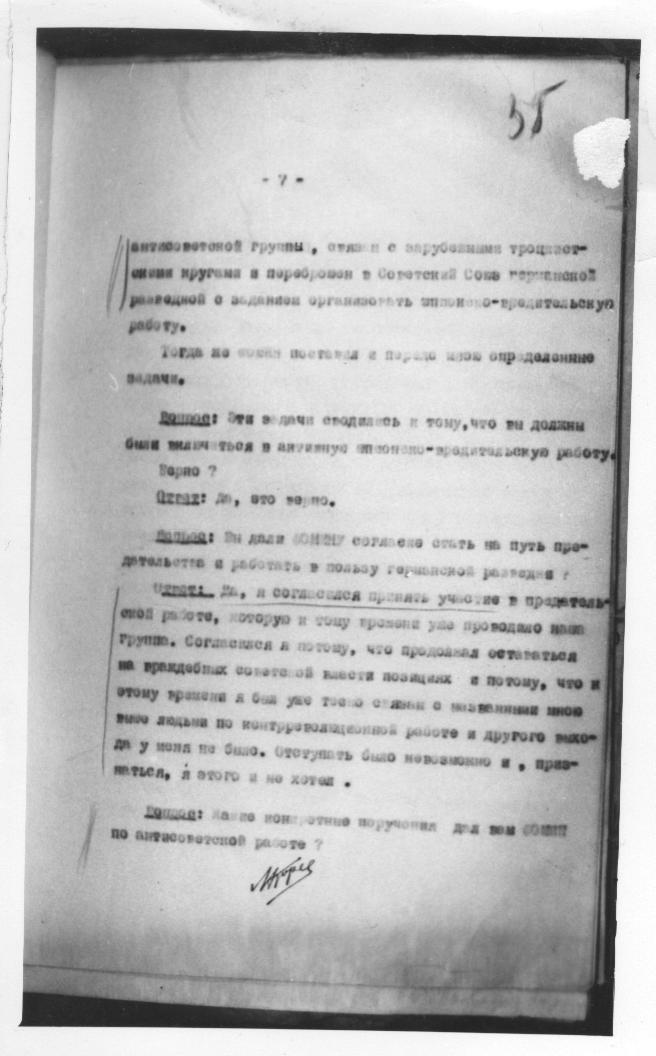
- 7 -
anti-Soviet group, is connected with abroad Trotskyist
circles and [illegible] into the Soviet Union by German
intelligence with the assignment to organize espionage-wrecking
work.
Then also FOMIN set before me too definite
tasks.
Question: These tasks came down to this, that you were
to join in active espionage-wrecking work.
Is that correct?
Answer: Yes, that is correct.
Question: You gave FOMIN consent to take the path of be-
trayal and to work for the benefit of German intelligence?
Answer: Yes, I agreed to take part in wrecking
work which by that time was already being carried out by our
group. I agreed because I continued to remain
on positions hostile to Soviet power and because by
that time I was already closely bound with the persons named by me
above in counterrevolutionary work and another way
out I did not have. To retreat was impossible and, to confess,
I did not want this either.
Question: What concrete assignments did FOMIN give you
in anti-Soviet work?
P. 36
A reading of the photograph, uncertain in places. Check it against the photograph.
36
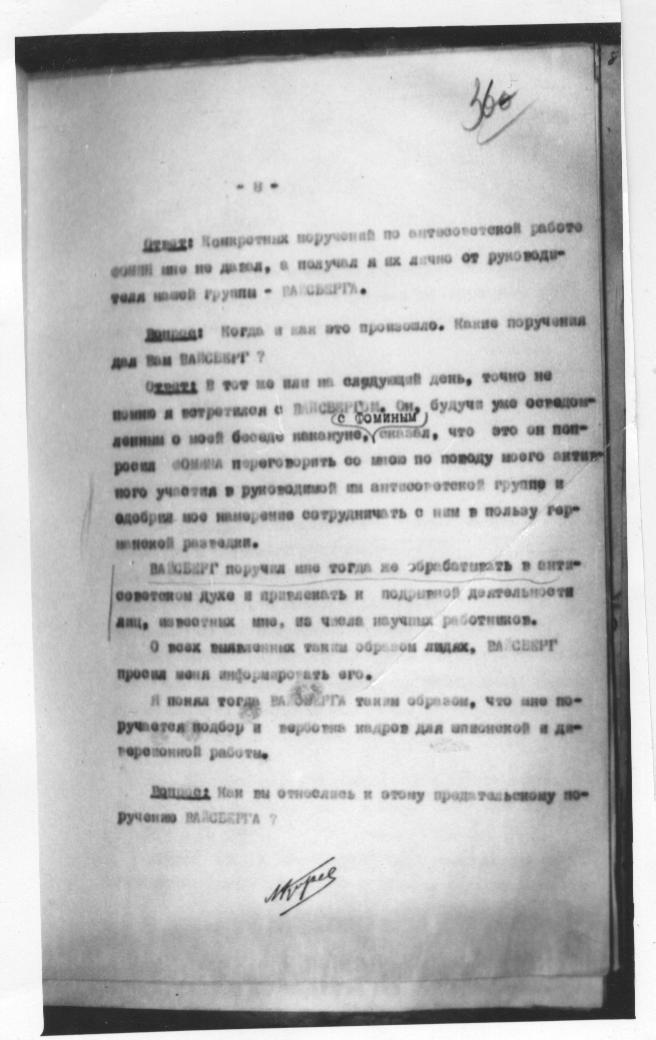
- 8 -
Answer: Concrete assignments in anti-Soviet work
FOMIN did not give me, and I received them personally from the lead-
er of our group — WEISSBERG.
Question: When and how did this happen. What assignments
did WEISSBERG give you?
Answer: On that same or on the next day, exactly I do not
remember, I met with WEISSBERG. He, being already infor-
med of my conversation the day before with FOMIN, said that it was he who had as-
ked FOMIN to speak with me concerning my active
participation in the anti-Soviet group led by him and
approved my intention to collaborate with him for the benefit of Ger-
man intelligence.
WEISSBERG assigned me then and there to work over people in an anti-
Soviet spirit and to draw into subversive activity
persons known to me, from among the scientific workers.
Of all persons identified in this way, WEISSBERG
asked me to inform him.
I understood WEISSBERG then in such a way, that to me was being as-
signed the selection and recruitment of cadres for espionage and di-
versionary work.
Question: How did you relate to this treacherous as-
signment of WEISSBERG?
P. 37
37
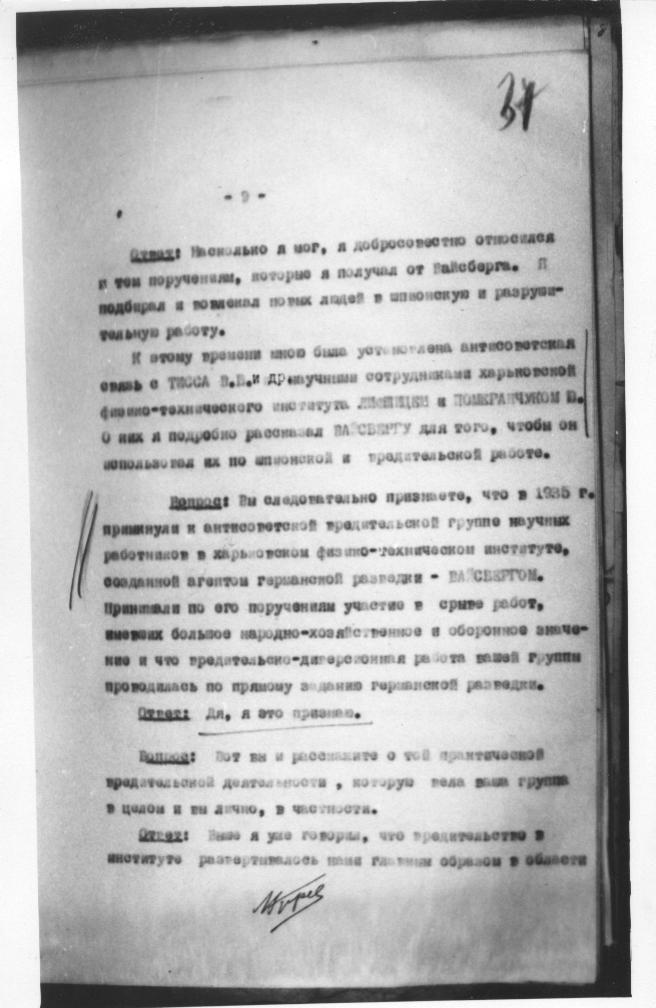
- 9 -
Answer: So far as I could, I conscientiously related
to those assignments which I received from Weissberg. I
selected and sent the needed people into espionage and destruc-
tive work.
By this time there had been established by me an anti-Soviet
connection with TISZA V.V. and oth. scientific workers of the Kharkov
Physico-Technical Institute, LANDAU and POMERANCHUK V.
Of them I told WEISSBERG in detail in order that he
might use them in espionage and wrecking work.
Question: You consequently admit that in 1935
you joined the anti-Soviet wrecking group of scientific
workers at the Kharkov Physico-Technical Institute,
created by an agent of German intelligence - WEISSBERG.
You took on his assignments part in the disruption of works
that had great national-economic and defense signifi-
cance and that the wrecking-diversionary work of your group
was conducted on the direct assignment of German intelligence.
Answer: Yes, I admit this.
Question: Then do you tell of that practical
wrecking activity which your group conducted
as a whole and you personally, in particular.
Answer: Above I already said that the wrecking at
the institute was unfolded by us chiefly in the field
Korets
P. 38
38
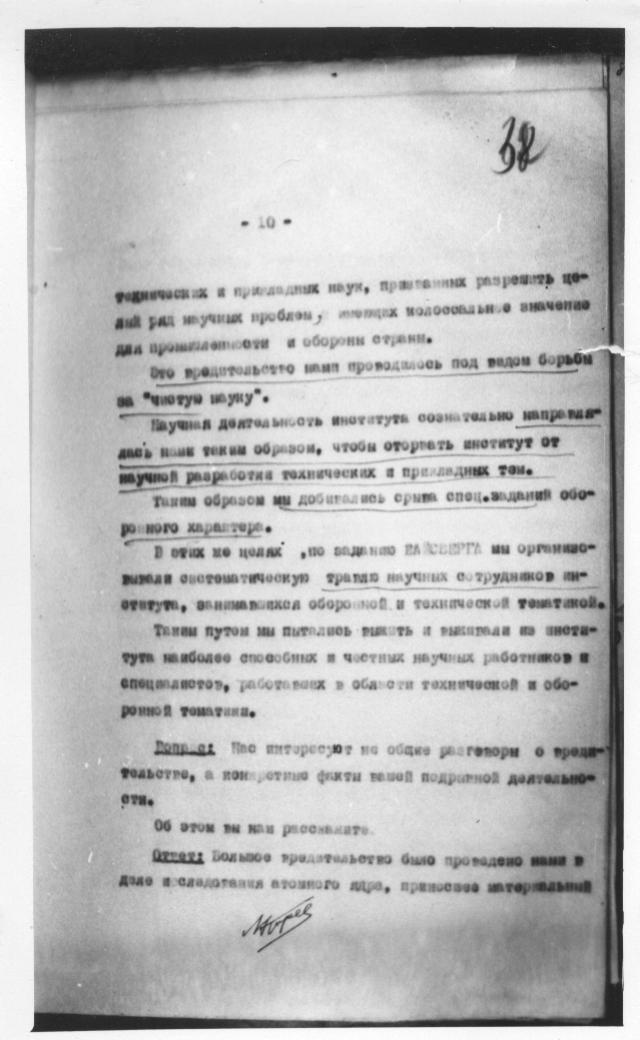
- 10 -
of the technical and applied sciences, called upon to resolve a who-
le series of scientific problems having colossal importance
for the industry and the defense of the country.
This wrecking was conducted by us under the guise of a struggle
for "pure science".
The scientific activity of the institute was consciously direc-
ted by us in such a way as to tear the institute away from
the scientific working-out of technical and applied themes.
In this way we achieved the disruption of spec.assignments of a de-
fense character.
For these same purposes, on the assignment of WEISSBERG, we organi-
zed a systematic hounding of the scientific workers of the in-
stitute who were engaged in defense and technical subject-matter.
By this path we tried to drive out and did drive out of the insti-
tute the most capable and honest scientific workers and
specialists who worked in the field of technical and de-
fense subject-matter.
Question: What interests us is not general talk about wreck-
ing, but concrete facts of your subversive activi-
ty.
About this you tell us.
Answer: A great wrecking was carried out by us in
the matter of the research of the atomic nucleus, which brought a material
Korets
P. 39
39
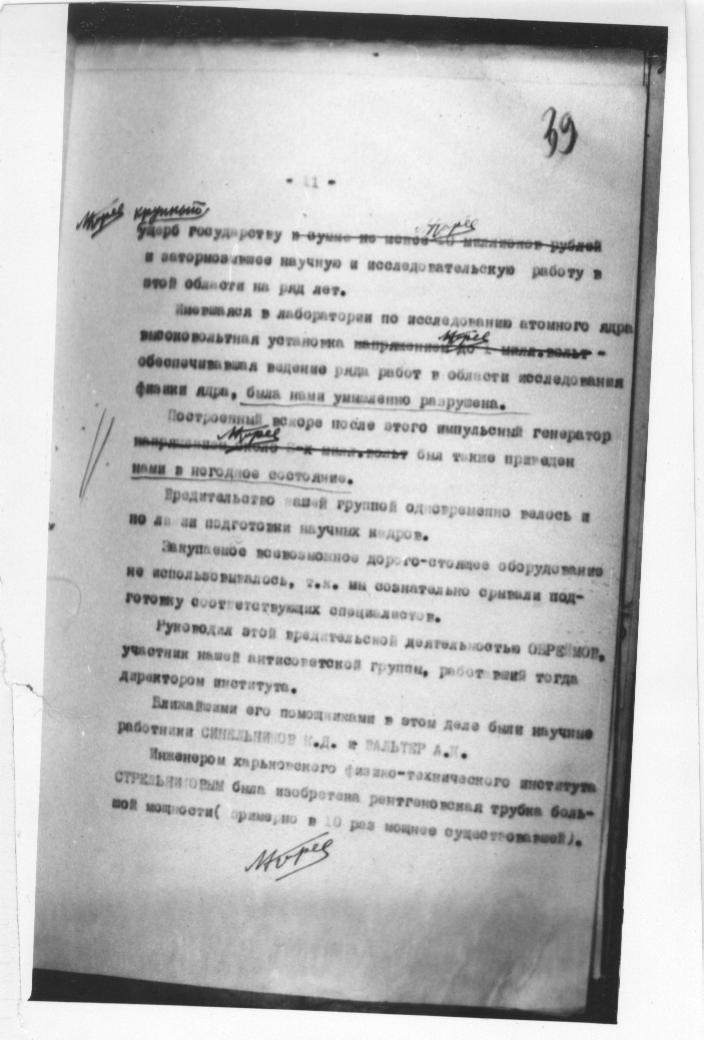
- 11 -
[in the margin] a major
blow to the state [struck out: in a sum of not less than [illegible] million rubles] [illegible]
and which held up the scientific and research work in
this field for a number of years.
The high-voltage installation that was on hand in the laboratory for research of the atomic nucleus
with a voltage of up to [struck out: [illegible]] [illegible] -
which ensured the conduct of a number of works in the field of research
of the physics of the nucleus, was by us deliberately destroyed.
The pulse generator built soon after this
[struck out: with a voltage of [illegible]] [illegible] was likewise brought
by us into an unfit condition.
Wrecking by our group was at the same time also conducted
along the line of the training of scientific cadres.
Purchased abroad, costly equipment
was not used, as we deliberately disrupted the pre-
paration of the corresponding specialists.
Directed this wrecking activity did OBREIMOV,
a participant of our anti-Soviet group, who then worked
as director of the institute.
His closest assistants in this matter were the scientific
workers SINELNIKOV K.D. and WALTER A.K.
By an engineer of the Kharkov Physico-Technical Institute
STRELNIKOV there was invented an X-ray tube of gre-
at power (approximately 10 times more powerful than the existing one).
Korets
P. 40
40
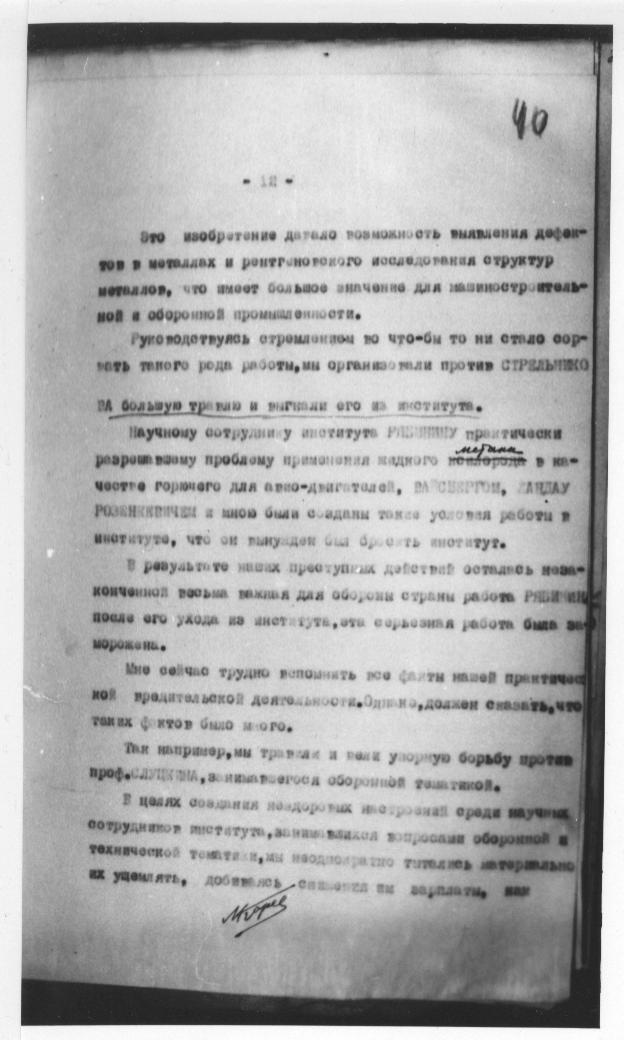
- 12 -
This invention gave the possibility of revealing defec-
ts in metals and of X-ray investigation of the structures
of metals, which has great importance for the machine-building
and defense industry.
Guided by the striving at whatever cost to disrup-
t work of such a kind, we organized against STRELNIKO
V a great hounding and drove him out of the institute.
To the scientific worker of the institute RYABININ, practically
solving the problem of the use of copper [struck out: [illegible]] [illegible] in the ca-
pacity of fuel for aircraft-engines, by WEISSBERG, LANDAU,
ROZENKEVICH and me there were created such conditions of work at
the institute that he was forced to abandon the institute.
As a result of our criminal actions there remained unfin-
ished a work of RYABININ very important for the defense of the country
after his departure from the institute, this serious work was fro-
zen.
It is difficult for me now to recall all the facts of our practi-
cal wrecking activity. However, I must say that
of such facts there were many.
Thus for example we hounded and waged a stubborn struggle against
Prof. SLUTSKIN, who was engaged in defense subject-matter.
For the purpose of creating unhealthy moods among the scientific
workers of the institute engaged in questions of defense and
technical subject-matter, we repeatedly tried materially
to squeeze them, seeking a lowering for them of pay, to us
Korets
P. 41
41
- 13 -
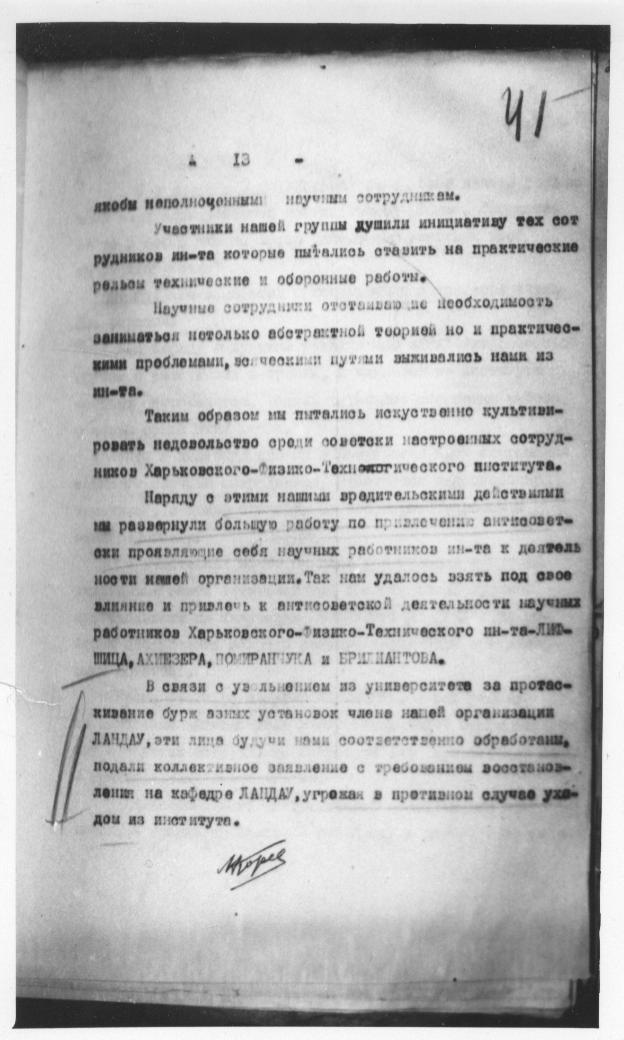
as supposedly inferior scientific workers.
Participants of our group stifled the initiative of those wor-
kers of the inst. who tried to set onto practical
rails technical and defense works.
Scientific workers who upheld the necessity
of occupying themselves not only with abstract theory but also with practi-
cal problems were by every sort of path driven out by us from
the inst.
In this way we tried artificially to culti-
vate dissatisfaction among Soviet-minded wor-
kers of the Kharkov Physico-Technological Institute.
Alongside these wrecking actions of ours
we unfolded a large work of drawing anti-Sov-
ietly manifesting themselves scientific workers of the inst. into activi
ty of our organization. Thus we managed to take under our
influence and to draw into anti-Soviet activity the scientific
workers of the Kharkov Physico-Technical Inst. LIF-
SHITS, AKHIEZER, POMERANCHUK and BRILLIANTOV.
In connection with the dismissal from the university for the smugg-
ling-in of bourgeois tenets of a member of our organization
LANDAU, these persons, having been by us correspondingly worked over,
submitted a collective statement with a demand for the reinstate-
ment to the chair of LANDAU, threatening in the contrary case with depar-
ture from the institute.
Korets
P. 42
42
- 14 -
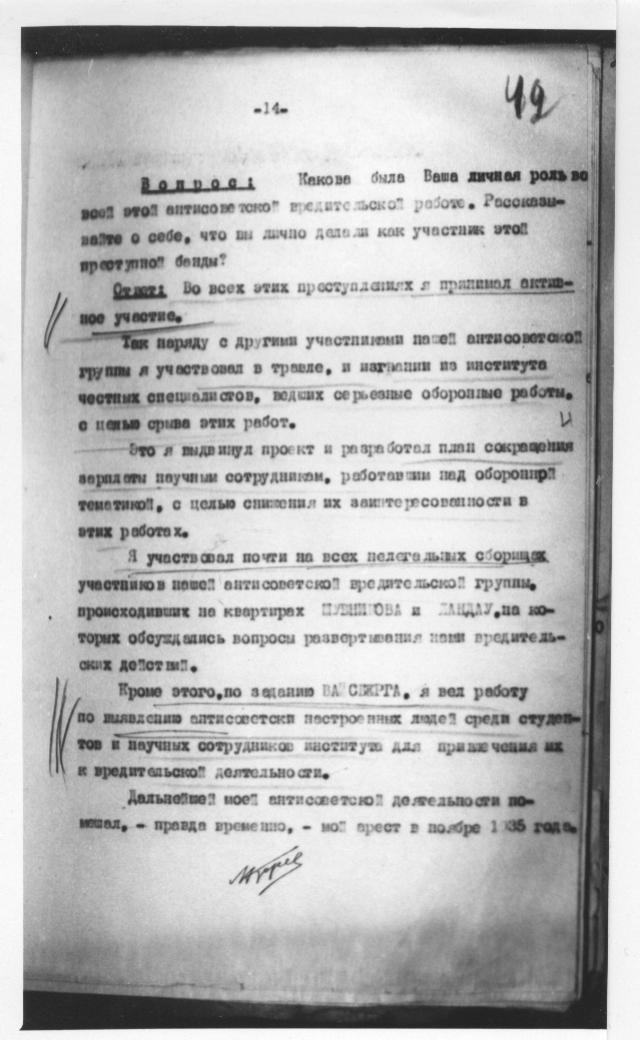
Question: What was your personal role in
all this anti-Soviet wrecking work. Tell
us about yourself, what did you personally do as a participant of this
criminal gang?
Answer: In all these crimes I took an active
part.
Thus alongside the other participants of our anti-Soviet
group I took part in the hounding and the driving out of the institute
of honest specialists who were conducting serious defense works,
with the aim of the disruption of these works.
It was I who put forward the project and worked out the plan of a reduction
of the pay to scientific workers who worked on defense
subject-matter, with the aim of lowering their interest in
these works.
I took part at almost all the illegal gatherings
of the participants of our anti-Soviet wrecking group,
which took place at the apartments of SHUBNIKOV and LANDAU, at whi-
ch there were discussed questions of the unfolding by us of wrecking
actions.
Besides this, on the assignment of WEISSBERG, I carried on work
of identifying anti-Sovietly minded people among the studen-
ts and scientific workers of the institute for drawing them
into wrecking activity.
Further anti-Soviet activity of mine was hin-
dered, - true, temporarily, - by my arrest in November 1935.
Korets
P. 43
43
- 15 -
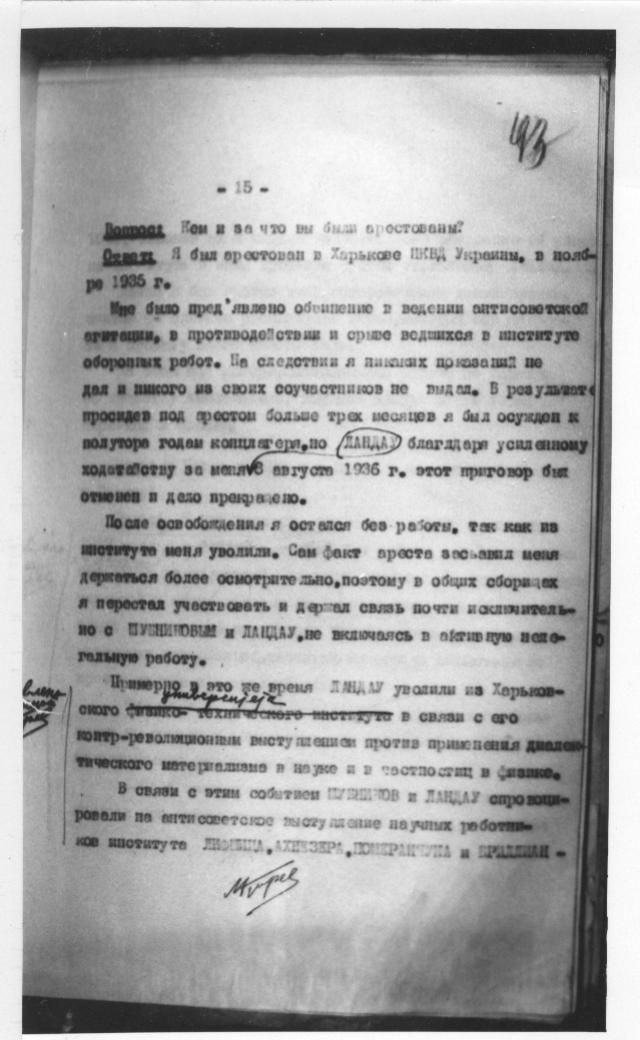
Question: By whom and for what were you arrested?
Answer: I was arrested in Kharkov by the NKVD of Ukraine, in Novem-
ber 1935.
There was presented to me a charge of conducting anti-Soviet
agitation, of counteraction to and disruption of those conducted at the institute
defense works. At the investigation I gave no testimony
and did not give away a single one of my accomplices. As a result,
having sat under arrest more than three months, I was sentenced to
a year and a half of concentration camp, but LANDAU thanks to vigorous
petitioning for me in August 1936 this sentence was
cancelled and the case discontinued.
After release I remained without work, since from
the institute I had been dismissed. The very fact of the arrest compelled me
to conduct myself more cautiously, therefore at general meetings
I ceased to take part and kept up a connection almost exclusive-
ly with SHUBNIKOV and LANDAU, without joining in active ille-
gal work.
At approximately this same time LANDAU was dismissed from the Kharkov
[struck out: Physico-Technical Institute] University in connection with his
counter-revolutionary statement against the application of dialec-
tical materialism in science and in particular in physics.
In connection with this event SHUBNIKOV and LANDAU provo-
ked into an anti-Soviet statement the scientific wor-
kers of the institute LIFSHITS, AKHIEZER, POMERANCHUK and BRILLIANTA -
[in the margin] [illegible]
Korets
P. 44
44
- 16 -
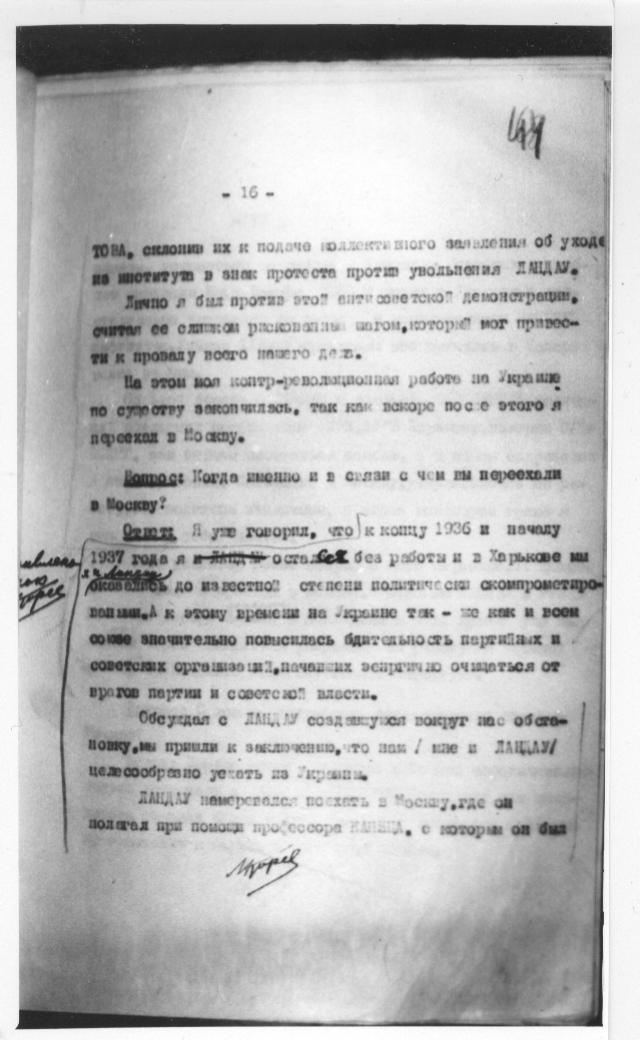
TOVA, having inclined them to the filing of a collective statement of departure
from the institute as a sign of protest against the dismissal of LANDAU.
Personally I was against this anti-Soviet demonstration,
considering it too risky a step, which could le-
ad to the failure of our whole affair.
With this my counter-revolutionary work in Ukraine
in essence ended, since soon after this I
moved to Moscow.
Question: When exactly and in connection with what did you move
to Moscow?
Answer: I already said that toward the end of 1936 and the beginning
of 1937 I [struck out: and LANDAU] were left without work and in Kharkov we
[in the margin] [illegible] found ourselves to a known degree politically comprom-
ised. And by this time in Ukraine, just as also in the whole
Union, there had considerably risen the vigilance of Party and
Soviet organizations, which had begun energetically to purge themselves of
enemies of the Party and of Soviet power.
Discussing with LANDAU what had formed around us, the situa-
tion, we came to the conclusion that for us / for me and LANDAU /
it was advisable to leave Ukraine.
LANDAU intended to go to Moscow, where he
supposed, with the help of Professor KAPITSA, with whom he was
Korets
P. 45
45
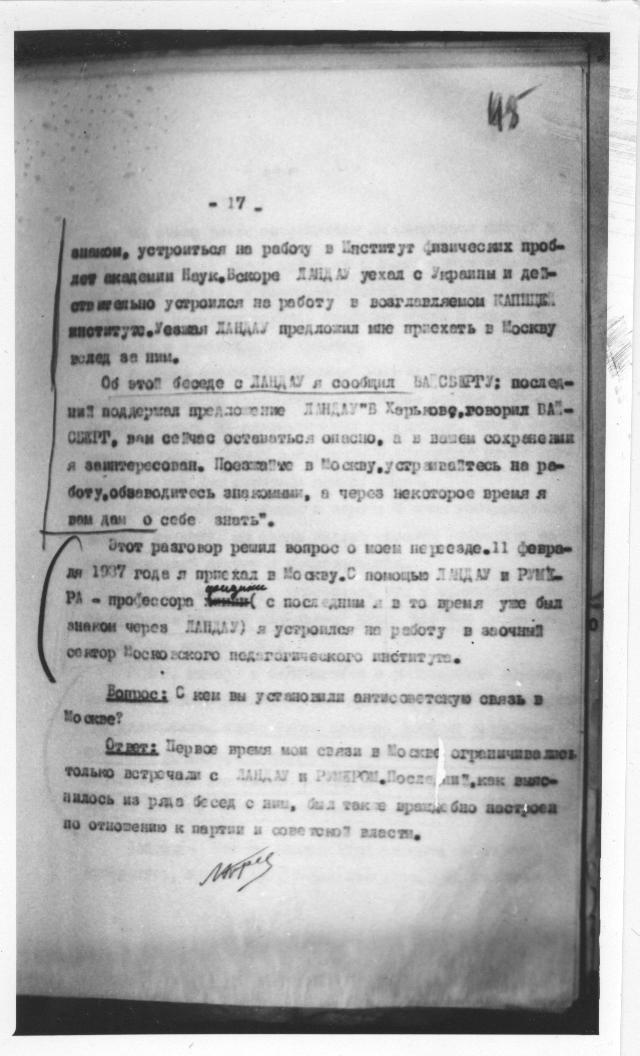
- 17 -
acquainted, to get himself work at the Institute of Physical Prob-
lems of the Academy of Sciences. Soon LANDAU left Ukraine and in-
deed got himself work at the institute headed by KAPITSA.
Then LANDAU proposed to me to come to Moscow
after him.
Of this conversation with LANDAU I informed WEISSBERG; the lat-
ter supported the proposal of LANDAU. "In Kharkov, said WEIS-
SBERG, it is now dangerous for you to remain, and in your preservation
I am interested. Go to Moscow, get yourself into wo-
rk, acquire acquaintances, and after some time I
will let you know of myself".
This conversation decided the question of my move. On 11 Febru-
ary 1937 I arrived in Moscow. With the help of LANDAU and RUME-
R - a professor [illegible] (with the latter I was at that time already
acquainted through LANDAU) I got myself work in the correspondence
section of the Moscow Pedagogical Institute.
Question: With whom did you establish an anti-Soviet connection in
Moscow?
Answer: At first my connections in Moscow were limited
only to meetings with LANDAU and RUMER. The latter, as it turned
out from a number of conversations with him, was also hostilely disposed
toward the Party and Soviet power.
Korets
P. 46
46
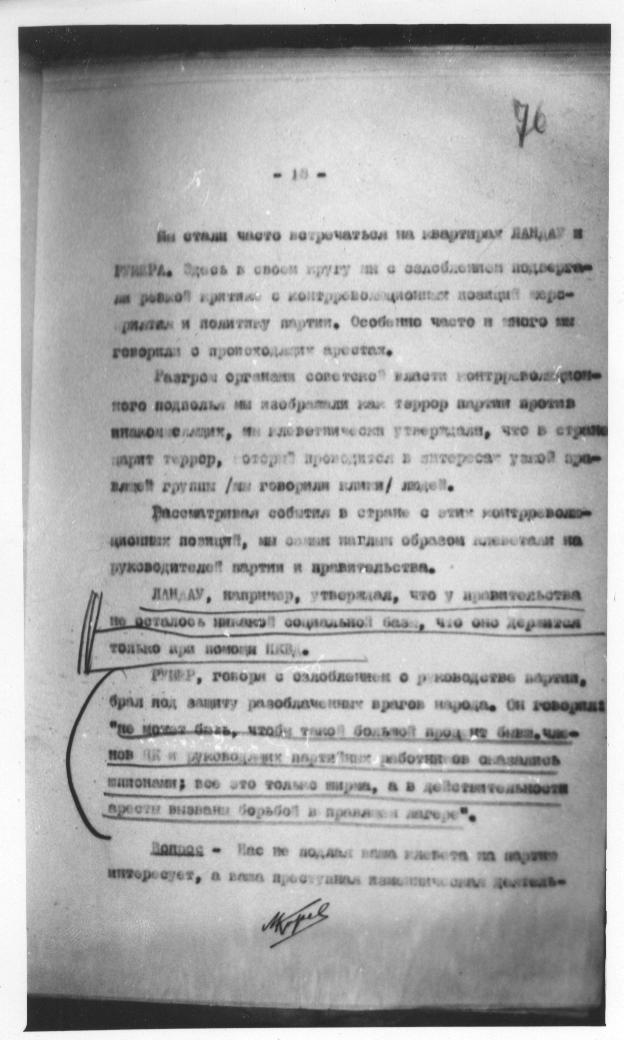
- 18 -
We began often to meet at the apartments of LANDAU and
RUMER. Here in our own circle we with bitterness subjected
for sharp criticism from counterrevolutionary positions the meas-
ures and the policy of the Party. Especially often and at length we
spoke of the arrests that were taking place.
The smashing by the organs of Soviet power of the counterrevolution-
ary underground we depicted as terror of the Party against
those who thought differently, we slanderously asserted that in the country
there reigns terror, which is carried out in the interests of a narrow ru-
ling group /we said a clique/ of people.
Considering the events in the country from these counterrevolu-
tionary positions, we in the basest manner slandered
the leaders of the Party and the government.
LANDAU, for example, asserted that the government
had left to it no social base whatever, that it holds on
only with the help of the NKVD.
RUMER, speaking with bitterness of the leadership of the Party,
took under defense the exposed enemies of the people. He said:
"It cannot be that such a large percentage was, mem-
bers of the CC and of leading Party workers turned out
spies; all this is only a screen, and in reality
there have been arrested fighters and devoted people".
Question: - What interests us is not [illegible] your slanders against the Party
but your criminal practical activi-
Korets
P. 47
47
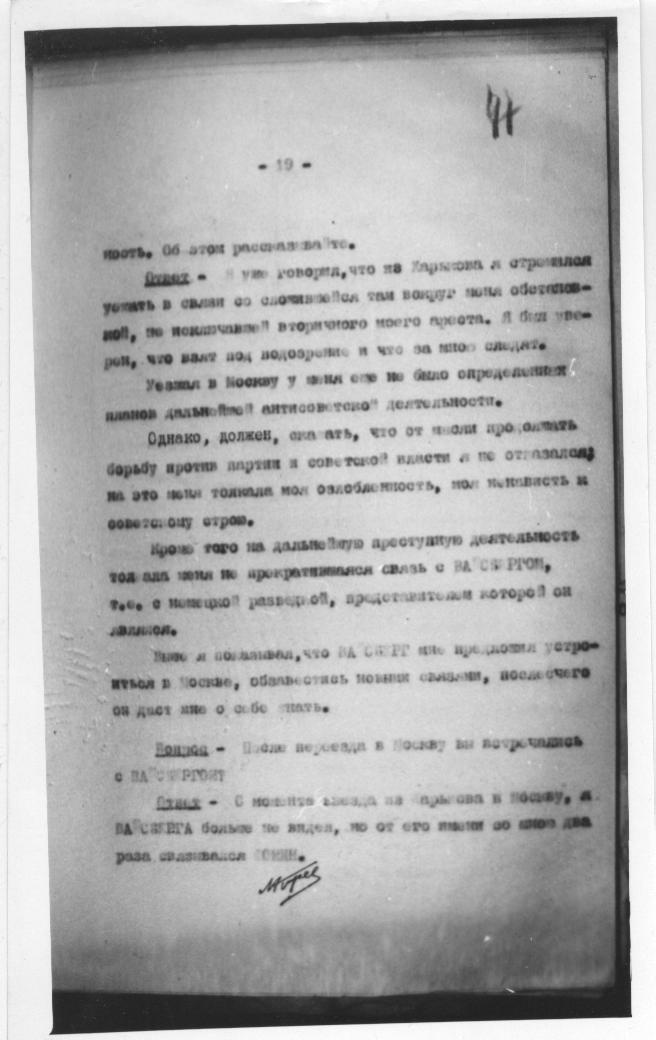
- 19 -
ty. Of this do the telling.
Answer: - I already said that from Kharkov I sought
to leave in connection with the situation that had formed there around me,
which did not exclude a second arrest of mine. I was su-
re that by you under suspicion and that I am being watched.
Leaving for Moscow I did not yet have definite
plans of further anti-Soviet activity.
However, I must say that from the thought of continuing
the struggle against the Party and Soviet power I did not desist;
to this I was pushed by my embitterment, my hatred toward
the Soviet order.
Besides that, to further criminal activity
I was pushed by the connection that had not ceased with WEISSBERG,
that is, with German intelligence, of which the representative he
was.
Above I testified that WEISSBERG proposed to me to get
settled in Moscow, to acquire new connections, after which
he would let me know of himself.
Question: - After the move to Moscow did you meet
with WEISSBERG?
Answer: - From the moment of my coming from Kharkov to Moscow, I
saw WEISSBERG no more, but in his name with me twice
FOMIN made contact.
Korets
P. 48
48
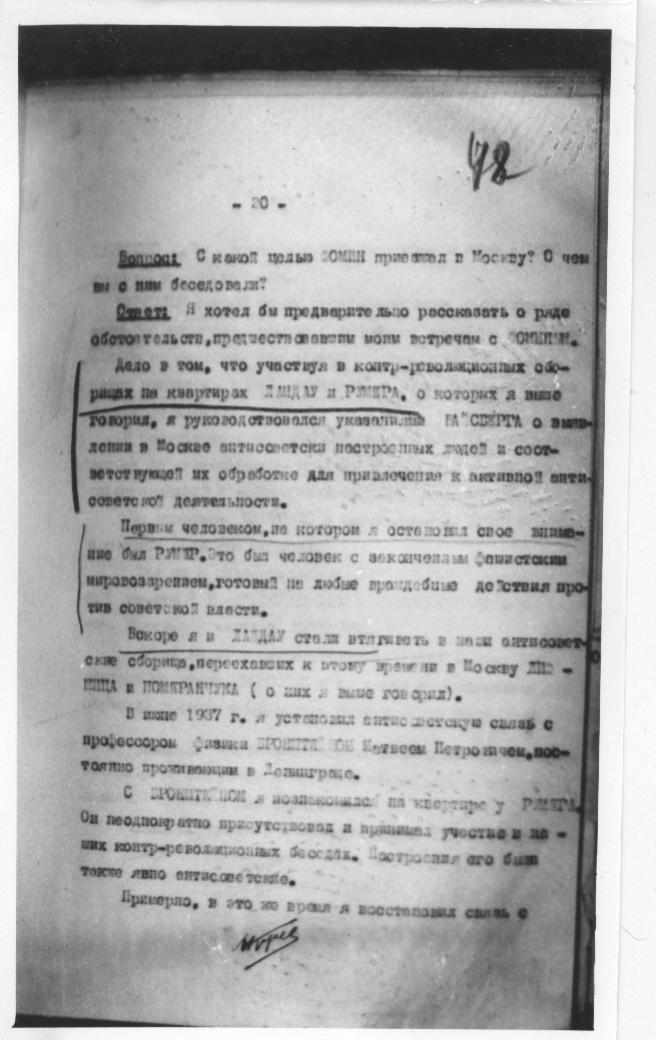
- 20 -
Question: With what aim did FOMIN come to Moscow? Of what
did you converse with him?
Answer: I should like first to tell of a number
of circumstances that preceded my meetings with FOMIN.
The point is that, taking part in counter-revolutionary gathe-
rings at the apartments of LANDAU and RUMER, of which I above
spoke, I was guided by the instructions of WEISSBERG on identi-
fying in Moscow anti-Sovietly minded people and a correspon-
ding working-over of them for drawing them into active anti-
Soviet activity.
The first person on whom I fixed my atten-
tion was RUMER. This was a man with a fully formed fascist
worldview, ready for any hostile actions aga-
inst Soviet power.
Soon I and LANDAU began to draw into our anti-Sov-
iet gatherings those who had by this time moved to Moscow, LIF-
SHITS and POMERANCHUK (of them I spoke above).
In June 1937 I established an anti-Soviet connection with
the professor of physics BRONSTEIN Matvei Petrovich, per-
manently residing in Leningrad.
With BRONSTEIN I became acquainted at the apartment of RUMER.
He repeatedly was present and took part in ou-
r counter-revolutionary conversations. His moods were
likewise openly anti-Soviet.
At approximately this same time I restored the connection with
Korets
P. 49
49
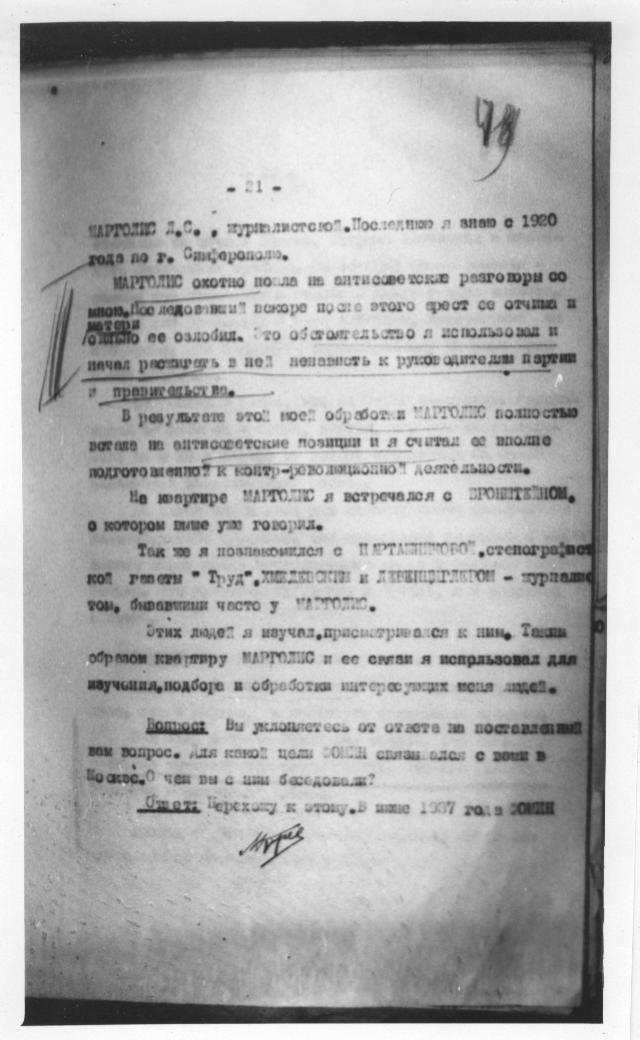
- 21 -
MARGOLIS L.S., a journalist. The latter I have known since 1920
from the city of Simferopol.
MARGOLIS willingly went into anti-Soviet conversations with
me. The arrest that followed soon after this of her father and
[in the margin] mother
embittered her greatly. This circumstance I made use of and
began to grow in her a hatred toward the leaders of the Party
and the government.
As a result of this working-over of mine MARGOLIS fully
stood onto anti-Soviet positions and I considered her fully
prepared for counter-revolutionary activity.
At the apartment of MARGOLIS I met with BRONSTEIN,
of whom above I already spoke.
Likewise I became acquainted with PARTASHNIKOVA, a stenogra-
pher of the newspaper "Trud", KHMELNITSKY and [illegible] - a journal-
ist, who were often at MARGOLIS's.
These people I studied, I looked closely at them. In this
way the apartment of MARGOLIS and her connections I used for
the study, selection and working-over of the people who interested me.
Question: You are evading an answer to the question put
to you. For what purpose did FOMIN make contact with you in
Moscow? Of what did you converse with him?
Answer: I am passing on to this. In June 1937 FOMIN
Korets
P. 50
50
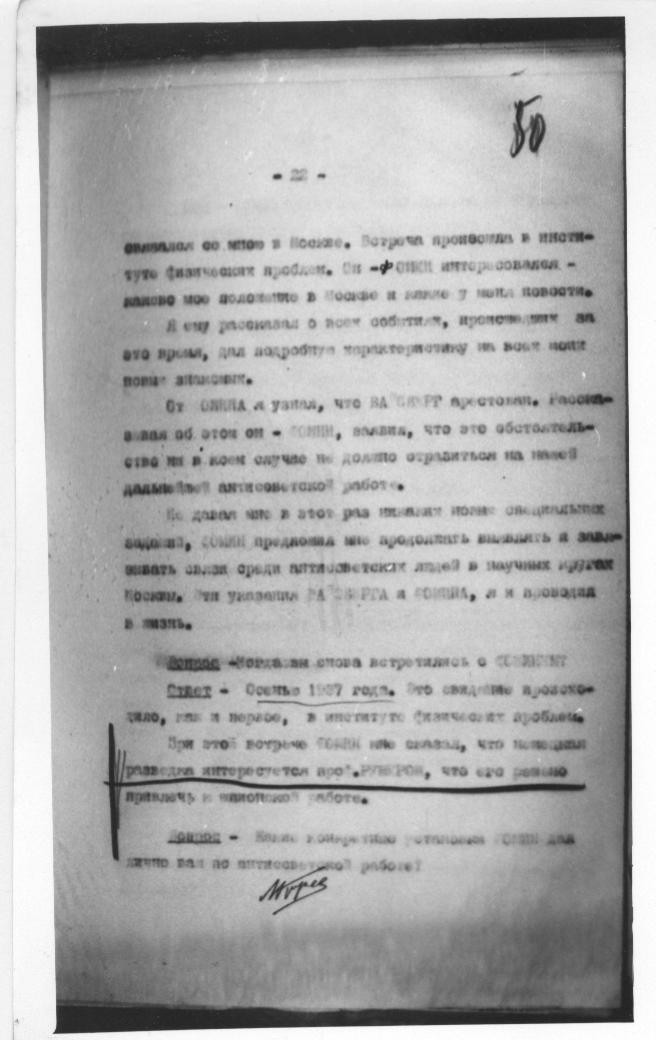
- 22 -
made contact with me in Moscow. The meetings took place at the Insti-
tute of Physical Problems. He - FOMIN was interested -
in what my situation was in Moscow and what news I had.
I told him of my event, which had taken place over
this time, gave a detailed characterization of all my
new acquaintances.
From FOMIN I learned that WEISSBERG had been arrested. Tel-
ling of this he - FOMIN declared that this circumstance
must in no case be reflected upon our
further anti-Soviet work.
Not giving me this time any new special
assignments, FOMIN proposed to me to continue to identify and to tie
connections among anti-Soviet people in the scientific circles
of Moscow. These instructions of WEISSBERG and of FOMIN I also put
into practice.
Question: When did you again meet with FOMIN?
Answer: - In the autumn of 1937. This meeting took pla-
ce, as did the first, at the Institute of Physical Problems.
At this meeting FOMIN said to me that German
intelligence is interested in Prof. RUMER, that it has been decided
to draw him into espionage work.
Question: - What concrete instructions did FOMIN give
personally to you in anti-Soviet work?
Korets
P. 51
51
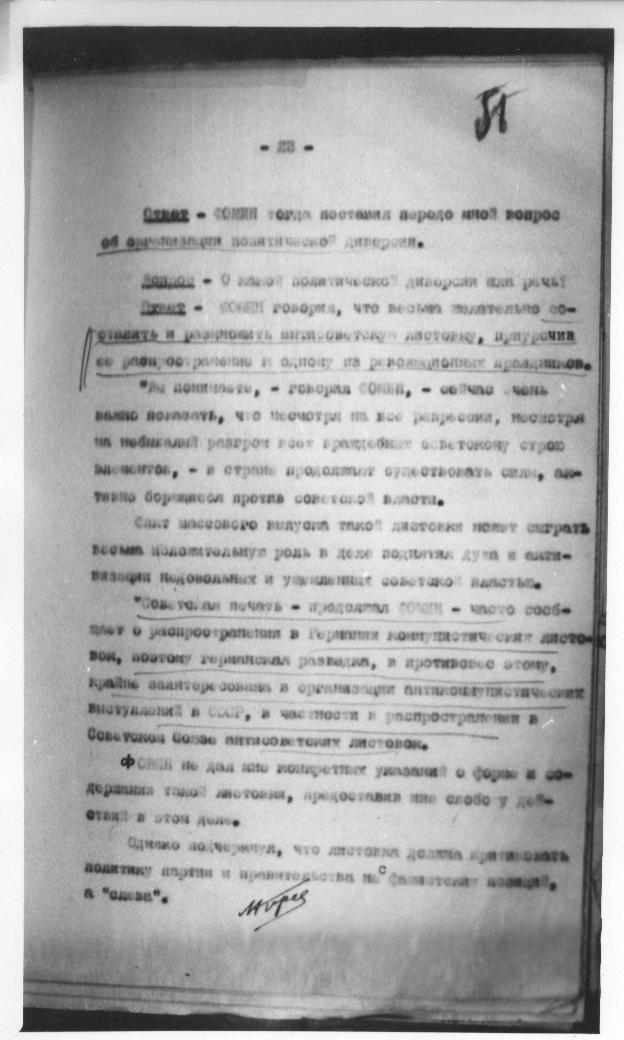
- 23 -
Answer: - FOMIN then put before me the question
of the organization of a political diversion.
Question: - Of what political diversion was there talk?
Answer: - FOMIN said that it was highly desirable to com-
pose and to duplicate an anti-Soviet leaflet, [illegible]
its distribution and [illegible] on revolutionary [illegible].
"You understand, - said FOMIN, - right now it is very
important to show that despite all the repressions, despite
the unprecedented smashing of all elements hostile to the Soviet order,
- in the country there continue to exist forces ac-
tively fighting against Soviet power.
The very mass issue of such a leaflet can play
a highly positive role in the matter of the raising of spirits and of the activ-
ization of the discontented and of those squeezed by Soviet power.
"The Soviet press - FOMIN continued - often re-
ports the distribution in Germany of communist leaf-
lets, therefore German intelligence, as a counterweight to this,
is extremely interested in the organization of anticommunist
actions in the USSR, in particular in the distribution in
the Soviet Union of anti-Soviet leaflets.
FOMIN did not give me concrete instructions as to the form and the con-
tent of such a leaflet, leaving me freedom of ac-
tion in this matter.
He did however emphasize that the leaflet must criticize
the policy of the Party and the government not from fascist positions,
but from "the left".
Korets
P. 52
52
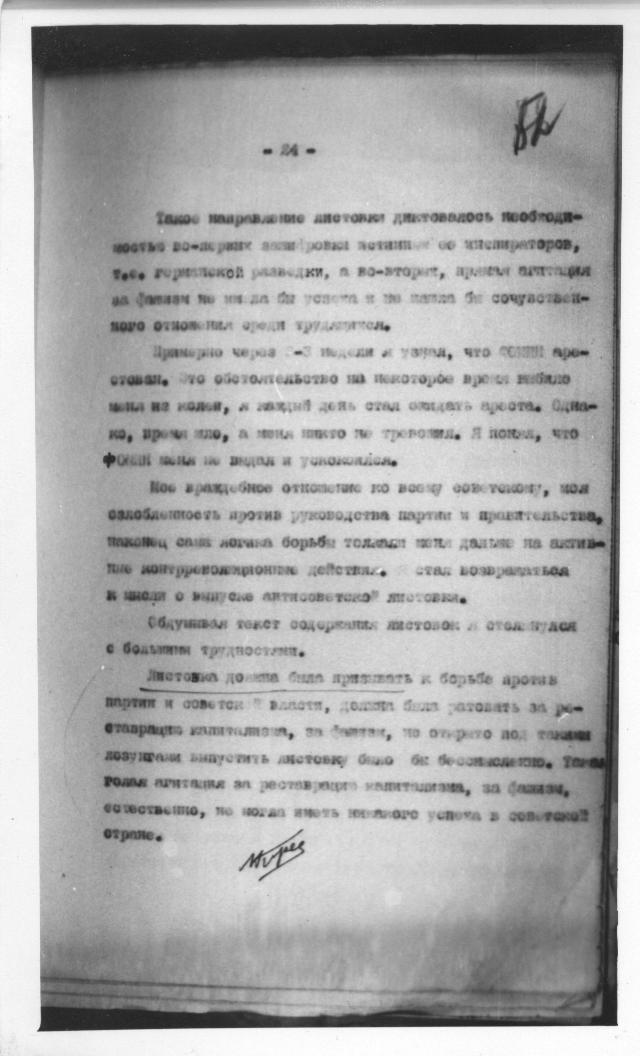
- 24 -
Such a direction of the leaflets was dictated by the necessi-
ty first of disguising the true inspirers of it,
that is, of German intelligence, and second, direct agitation
for fascism could not [illegible] and would not have found a sympathe-
tic attitude among the working people.
Approximately in 2-3 weeks I learned that FOMIN had been arre-
sted. This circumstance for some time threw
me off the rails, and every day I began to expect arrest. How-
ever time went on and no one troubled me. I understood that
FOMIN had not given me away and I calmed down.
My hostile attitude to everything Soviet, my
embitterment against the leadership of the Party and the government,
finally the very logic of the struggle pushed me further to active
counterrevolutionary actions. I began to return
to the thought of the issue of an anti-Soviet leaflet.
I thought over the text of the content of the leaflets and ran
into great difficulties.
The leaflet was to call to a struggle against
the Party and Soviet power, was to champion the re-
storation of capitalism, of fascism, but openly under such
slogans to issue a leaflet would have been senseless. Such
bare agitations for the restoration of capitalism, for fascism,
naturally could have no success whatever in the Soviet
country.
Korets
P. 53
53
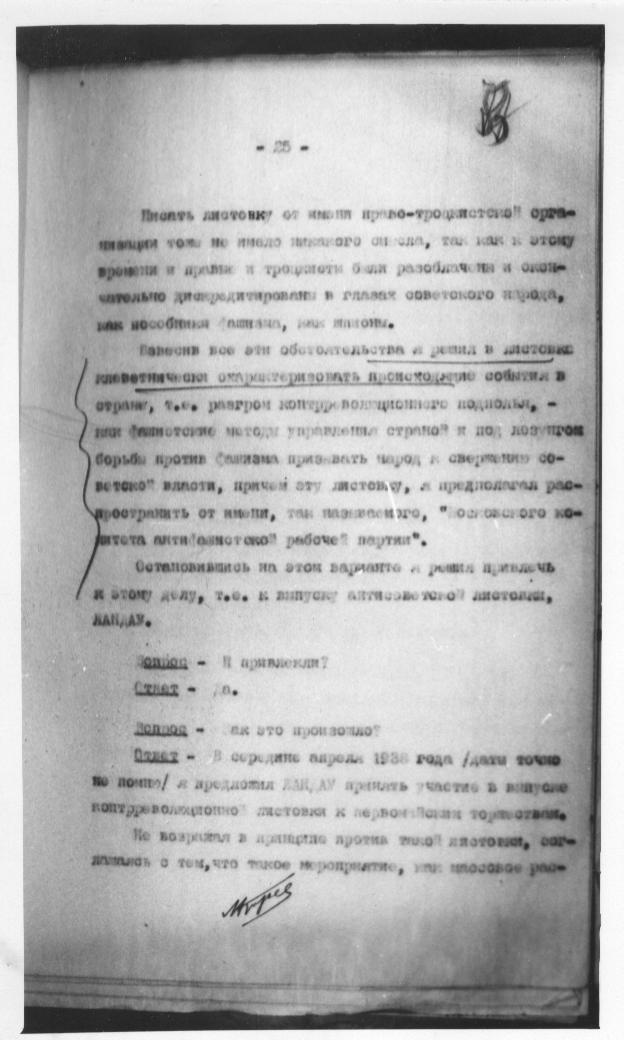
- 25 -
To write a leaflet in the name of a Right-Trotskyist orga-
nization likewise had no sense whatever, since by this
time both the Rightists and the Trotskyists had been exposed and final-
ly discredited in the eyes of the Soviet people,
as accomplices of fascism, as spies.
Having weighed all these circumstances I decided in the leaflet
slanderously to characterize the events taking place in
the country, that is, the smashing of the counterrevolutionary underground, -
as fascist methods of governing the country and under the slogan
of a struggle against fascism to call the people to the overthrow of So-
viet power, and this leaflet I intended to dis-
tribute in the name of the so-called "Moscow Com-
mittee of the Antifascist Workers' Party".
Having settled on this variant I decided to draw
into this matter, that is, into the issue of an anti-Soviet leaflet,
LANDAU.
Question: - And did you draw him in?
Answer: - Yes.
Question: - How did this come about?
Answer: - In the middle of April 1938 /the date exactly
I do not remember/ I proposed to LANDAU to take part in the issue
of a counterrevolutionary leaflet for the May Day celebrations.
Not objecting in principle to such a leaflet, ag-
reeing that such a measure, as a mass dis-
Korets
P. 54
54
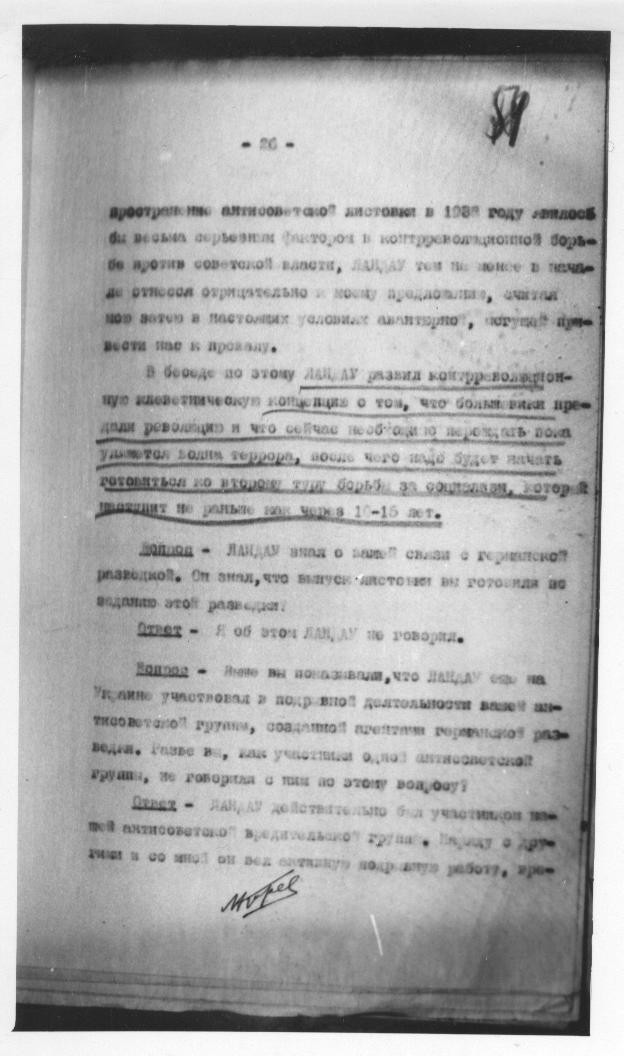
- 26 -
tribution of an anti-Soviet leaflet in 1938 would have
been a very serious factor in the counterrevolutionary strug-
gle against Soviet power, LANDAU nevertheless at the begin-
ning related negatively to my proposal, considering
my affair in the present conditions an adventure that might
lead us to failure.
In the conversation on this LANDAU developed a counterrevolution-
ary slanderous conception to the effect that the Bolsheviks had be-
trayed the revolution and that now it is necessary to wait until
the wave of terror subsides, after which it will be necessary to begin
to prepare for the second round of the struggle for socialism, which
will set in no earlier than in 15-16 years.
Question: - Did LANDAU know of your connection with German
intelligence? Did he know that the issue of the leaflet you were preparing on
the assignment of this intelligence?
Answer: - Of this I did not speak to LANDAU.
Question: - Above you testified that LANDAU already in
Ukraine took part in the subversive activity of your an-
ti-Soviet group, created by an agent of German intelli-
gence. Surely you, as participants of one anti-Soviet
group, did not speak with him on this question?
Answer: - LANDAU indeed was a participant of
our anti-Soviet wrecking group. Alongside the oth-
ers and with me he carried on active subversive work, wreck-
Korets
P. 55
55
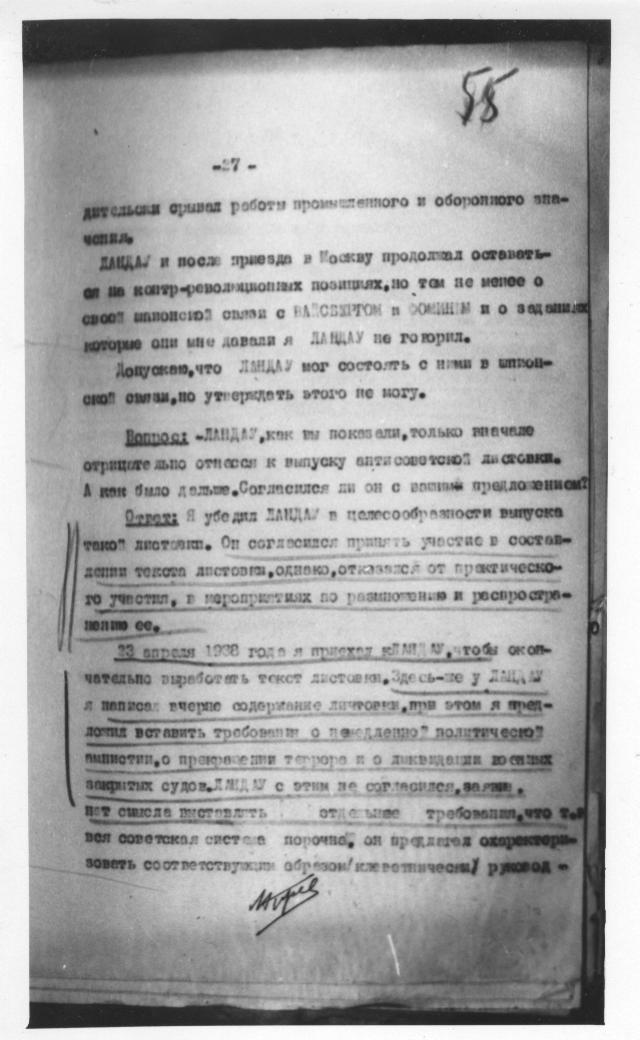
- 27 -
ingly disrupted works of industrial and defense signifi-
cance.
LANDAU also after his arrival in Moscow continued to re-
main on counter-revolutionary positions, but nevertheless of
my espionage connection with WEISSBERG and FOMIN and of the assignments
which they gave me I did not speak to LANDAU.
I allow that LANDAU might have been with them in an espio-
nage connection, but to assert this I cannot.
Question: - LANDAU, as you have testified, only at first
related negatively to the issue of an anti-Soviet leaflet.
And how it was further. Did he agree to your proposal?
Answer: I convinced LANDAU of the advisability of the issue
of such a leaflet. He agreed to take part in the compo-
sing of the text of the leaflet, however he refused practical
participation in the measures for the duplicating and the distribu-
ting of it.
On 23 April 1938 I came to LANDAU in order finally to
work out the text of the leaflet. Right there at LANDAU's
I wrote in draft the content of the leaflet; at this I pro-
posed to insert demands for an immediate political
amnesty, for a cessation of the terror and for the liquidation of military
[illegible] courts. LANDAU did not agree to this, declaring
there is no sense in putting forward separate demands, that since
the Soviet system is vicious, he proposed to character-
ize in the corresponding manner /slanderously/ the leader-
Korets
P. 56
56
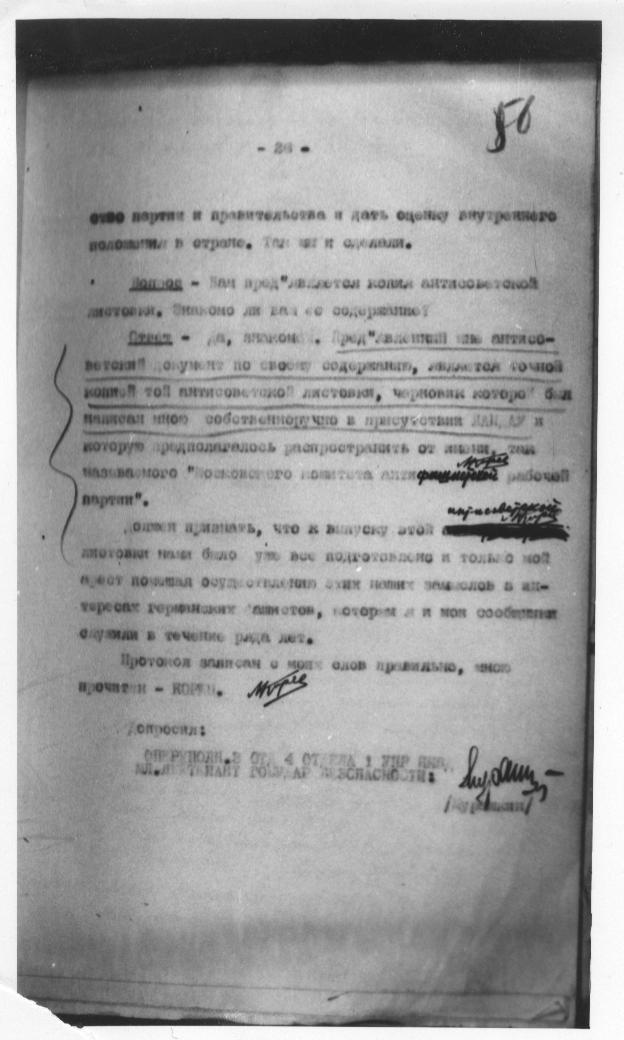
- 28 -
ship of the Party and the government and to give an assessment of the internal
situation in the country. And so we did.
Question: - There is presented to you a copy of an anti-Soviet
leaflet. Is its content known to you?
Answer: - Yes, known. The anti-So-
viet document presented to me is in its content an exact
copy of that anti-Soviet leaflet the draft of which was
written by me with my own hand in the presence of LANDAU and
which it was supposed to distribute in the name of the so-
called "Moscow Committee [struck out: Antifascist] [illegible] Workers'
Party".
[struck out: [illegible]] [illegible] I must admit that for the issue of this
leaflet by us everything had already been prepared and only my
arrest prevented the carrying out of these designs of ours in the in-
terests of the German fascists, whom I and my accomplices
served in the course of a number of years.
The record has been written down from my words correctly, by me
read - KORETS.
Korets
Interrogated by:
OPERATIONS OFFICER OF THE 3rd SEC. OF THE 4th DEPARTMENT OF THE 1st DIR. NKVD
JR. LIEUTENANT OF STATE SECURITY
[illegible]
/[illegible]/
The text is taken from photographs of the case file. Words that could not be made out are marked [illegible]. Where a page is too faint, only the photograph is left.